 en
en русский
 Español
 عربى
عربى
Air Separation Plant: Complete Guide for Industrial Gas Production
Industrial Gas / Air Separation Technology
Content
Air Separation Plant
A complete technical guide to air separation plants — cryogenic distillation, applications, and industrial gas production.
An air separation plant is an industrial facility that separates atmospheric air into its primary components — nitrogen, oxygen, and argon — using cryogenic distillation or other separation technologies. These plants are essential for producing high-purity industrial gases used across numerous industries.
Air separation plants are the backbone of the industrial gas industry. They supply oxygen for steelmaking and medical applications, nitrogen for chemical processing and food preservation, and argon for welding and electronics manufacturing. The scale of these plants ranges from small packaged units to massive facilities producing thousands of tons of gas per day.
Air separation plants turn the air we breathe into the gases that power modern industry.
What Is an Air Separation Plant
Air separation plants are industrial facilities designed to separate atmospheric air into its component gases through cryogenic distillation. The process relies on the fact that different gases liquefy at different temperatures — oxygen at -183°C, nitrogen at -196°C, and argon at -186°C.
Atmospheric air is first compressed, purified to remove carbon dioxide and water vapor, and then cooled to cryogenic temperatures. The liquefied air is fed into a distillation column where the components are separated based on their boiling points. This process yields high-purity nitrogen, oxygen, and argon, along with rare gases like neon, krypton, and xenon.
Air separation plants can be designed with different production capacities and purity levels depending on the end-use requirements. Some plants produce gases in gaseous form, while others produce liquid products for storage and transport.
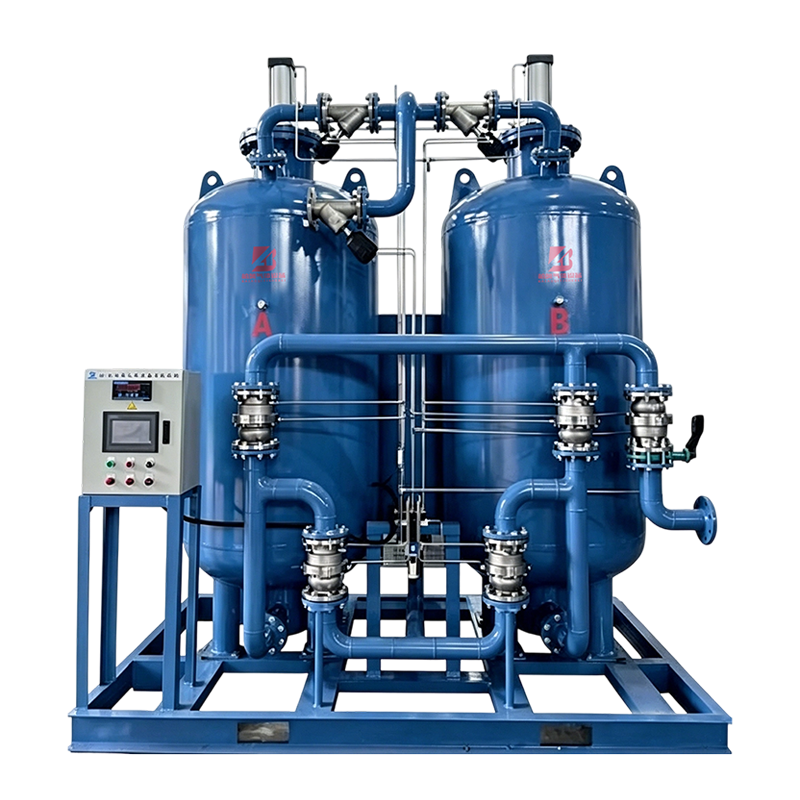
Colorless, odorless, inert gas. Used for blanketing, purging, and chemical processing. Purity: 99.999%+ available.
Colorless, odorless, reactive gas. Used for steelmaking, medical, and wastewater treatment. Purity: up to 99.5%.
Colorless, odorless, inert gas. Used for welding, electronics, and metal production. Purity: 99.999%+ available.
Neon, krypton, xenon — used in lighting, lasers, and electronics. Produced in small quantities from air.
How Air Separation Plants Work
Air separation plants operate on the principle of cryogenic distillation. The process involves several key stages:
Atmospheric air is drawn into the plant and compressed to high pressure using multi-stage compressors. The compression raises the temperature of the air, which is then cooled by intercoolers.
The compressed air passes through molecular sieve beds that remove carbon dioxide, water vapor, and hydrocarbons. These contaminants would freeze and block the cryogenic equipment.
The purified air is cooled in heat exchangers against product and waste streams. The air is cooled to cryogenic temperatures (below -170°C) until it liquefies.
The liquefied air enters the distillation column. Nitrogen (boiling point -196°C) rises to the top, oxygen (-183°C) collects at the bottom, and argon (-186°C) is drawn from the middle section.
Air Intake to Compression to Purification to Cooling to Liquefaction to Distillation to Product Storage
Key Equipment and Components
Air separation plants consist of several critical components that work together to achieve efficient separation:
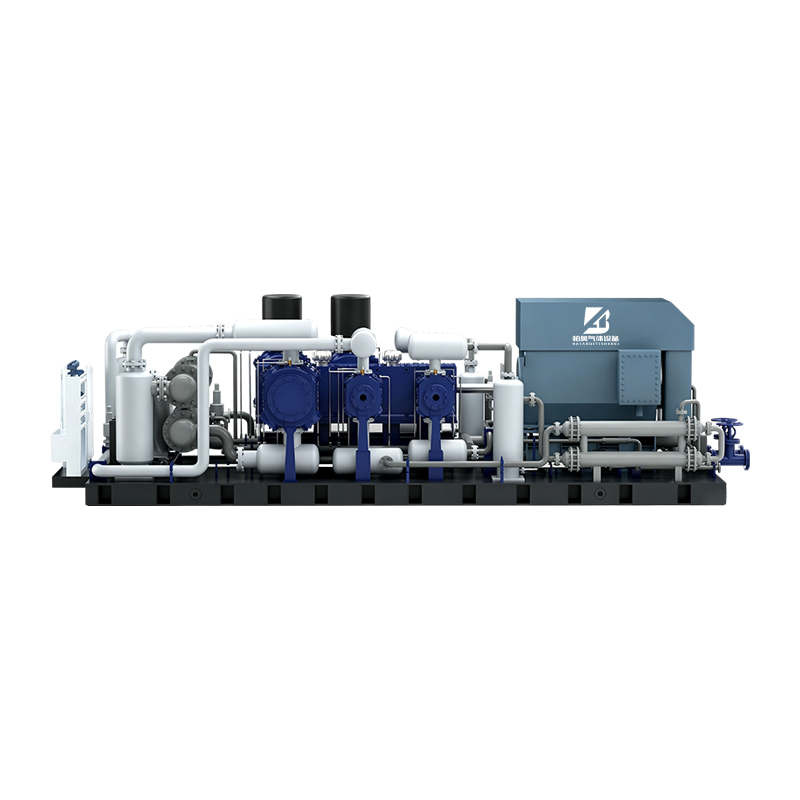
Multi-stage centrifugal or reciprocating compressors that pressurize atmospheric air to the required operating pressure.
Vessels filled with molecular sieve material that remove CO2, H2O, and hydrocarbons from the compressed air stream.
Brazed aluminum or plate-fin heat exchangers that cool the process air to cryogenic temperatures.
High-efficiency distillation columns with structured packing or sieve trays that separate the air components.
Turbo-expanders that generate refrigeration by expanding a portion of the compressed air.
Cryogenic storage tanks for liquid products and gas storage systems for gaseous products.
Comparison of Air Separation Technologies
| Technology | Capacity | Purity | Energy Consumption | Best Application |
|---|---|---|---|---|
| Cryogenic Distillation | 50-5000+ tpd | Up to 99.999% | Moderate-High | Large-scale, high-purity |
| PSA | 10-500 tpd | 90-99.5% | Low-Moderate | Small-scale, lower purity |
| Membrane | 1-100 tpd | 90-99% | Low | Small-scale, nitrogen |
Applications
Air separation plants supply gases to virtually every industrial sector:
Oxygen injection for combustion enhancement and impurity removal in blast furnaces and electric arc furnaces.
Nitrogen for inerting, purging, and pressure transfer. Oxygen for oxidation reactions and waste treatment.
Medical oxygen for hospitals and healthcare facilities. Nitrogen for pharmaceutical processing.
Nitrogen for food packaging and preservation. Cryogenic freezing of food products.
High-purity nitrogen and argon for semiconductor manufacturing and electronics production.
Oxygen for life support systems. Nitrogen for inerting fuel tanks and systems.
Selection Guide
Selecting the right air separation plant requires careful consideration of several factors:
Identify the type, purity, and volume of gas required for your application.
Evaluate the required production capacity — small-scale PSA systems may be suitable for lower volumes.
Choose between cryogenic distillation, PSA, or membrane technologies based on purity and capacity requirements.
Evaluate site conditions, utilities availability, and proximity to gas distribution networks.
Determine if liquid storage or gaseous storage is required for buffer capacity.
Consider energy consumption and operating costs in the technology selection process.
Frequently Asked Questions
- Tel: +86-15057127179
+86-13588382771 - Email: huang.yifan0215@gmail.com
- Address: Huanshan Township, Fuyang District, Hangzhou City, Zhejiang Province
Copyright © Zhejiang Baiao Gas Equipment Co., Ltd. All Rights Reserved.
Privacy
Gas Generator Plant Manufacturer, Industrial Purification Equipment Plant
