
 en
en русский
 Español
 عربى
عربى











Industry Knowledge: Matching Gas Form and Supply Method to Each Food & Beverage Process
The pain points above cover five distinct uses of nitrogen and oxygen — packaging, freezing, fermentation, general supply cost, and safety. Not all of them call for the same gas form or the same equipment, which matters when specifying a system for a real production line.
| Application (as stated on this page) | Gas / form | Why it works |
|---|---|---|
| Modified atmosphere packaging & tank blanketing | Gaseous nitrogen | Displaces oxygen inside the package or tank headspace, removing the oxygen that drives oxidation, mold growth, and rancidity |
| Beverage & alcohol filling | Gaseous nitrogen | Purges oxygen from the container before filling to prevent flavor and color degradation; can also replace CO&sub2; for beer pressure regulation |
| Aeration & fermentation | Gaseous oxygen | Raises dissolved oxygen available to aerobic microbes, which is what limits fermentation rate once other conditions are controlled |
| Grinding & milling protection | Gaseous nitrogen | Inert atmosphere denies the oxygen a dust explosion needs, alongside limiting oxidative flavor loss from heat generated during grinding |
| Cold chain & quick freezing | Liquid nitrogen | Direct contact with cryogenic liquid freezes product fast enough to limit ice crystal formation — see note below on equipment |
Scenarios and stated outcomes above are as published on this page; the gas-form column and mechanism explanations are added here.
Why Packaging and Blanketing Run on Gaseous Nitrogen, But Quick-Freezing Needs a Different Supply
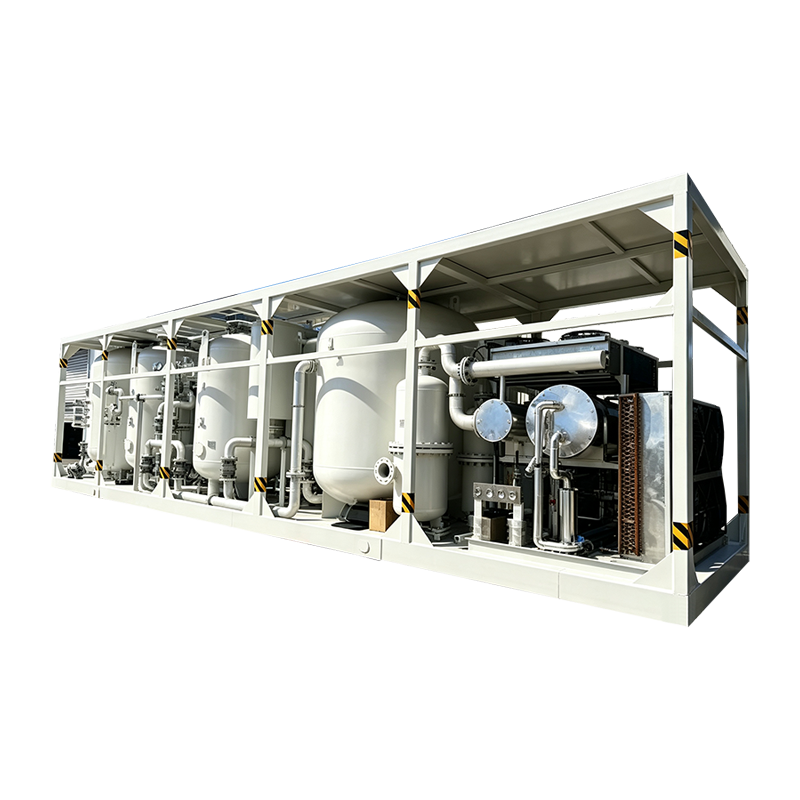
An on-site PSA nitrogen generator produces gaseous nitrogen at moderate pressure — the right form for modified atmosphere packaging, tank blanketing, and oxygen purging before filling, which covers most of the pain points on this page. Ultra-fast freezing and cryogenic grinding, however, specifically need liquid nitrogen at around -196°C, which requires a separate cryogenic liquefaction process rather than the pressure-swing adsorption or membrane separation technology behind on-site gaseous nitrogen generation. A production line running both a gas-fed packaging line and a liquid nitrogen freezing tunnel typically sources the two separately — on-site PSA nitrogen for the gas-phase uses, and bulk-delivered or separately liquefied nitrogen for the cryogenic freezing step — rather than expecting one system to supply both.
Why Fermentation Needs Continuous Oxygen, Not a Batch Dose
Aerobic fermentation — brewing, vinegar, yogurt, yeast production — consumes dissolved oxygen continuously as the microbial culture grows, so oxygen has to be replenished throughout the batch rather than added once at the start. An on-site oxygen generator sized for the tank's peak microbial oxygen demand, not just its average, is what keeps fermentation rate and flavor consistent from batch to batch — undersizing for peak demand is a common way fermentation efficiency falls short even when average oxygen supply looks adequate on paper.
Frequently Asked Questions
Can one on-site system supply both packaging-grade nitrogen and fermentation oxygen at the same facility?
Yes, but typically as two separate generators rather than one unit switching gases — nitrogen and oxygen PSA systems use different adsorbent media, so a facility running both processes usually installs a nitrogen generator and an oxygen generator (both covered above) sized independently for each process's demand.
Does Zhejiang Baiao Gas Equipment Co., Ltd. supply liquid nitrogen equipment for quick-freezing?
No — the company's air separation equipment (PSA, VPSA, and membrane) produces gaseous nitrogen and oxygen. Liquid nitrogen for cryogenic freezing requires a separate cryogenic liquefaction process and is normally sourced independently of an on-site gas-phase nitrogen system.
Is on-site generation actually cheaper than purchased cylinder or liquid gas for a food plant?
For continuous, high-volume use it generally is, since it removes recurring delivery and cylinder rental costs after the initial equipment investment — this page doesn't publish a specific percentage for food and beverage, so it's worth requesting a project-specific comparison against your actual current gas spend rather than assuming a figure quoted for a different industry applies here.
