 en
 русский
 Español
 عربى

Air Compressor Selection Guide: Lifecycle Cost, Oil-Free vs Oil-Injected
Content
- 1 Why Electricity, Not the Purchase Order, Decides What an Air Compressor Costs
- 2 Oil-Injected or Oil-Free: Match the Air Compressor to the Process, Not the Price Tag
- 3 Air Treatment Decides Whether Your Air Compressor Is an Asset or a Corrosion Source
- 4 Sizing an Air Compressor: Five Checks That Change the Final Quote
- 5 Frequently Asked Questions About Air Compressor Selection
A 75 kW screw compressor running 6,000 hours a year draws about 450,000 kWh of electricity. At an industrial rate of USD 0.11 per kWh that is close to USD 49,500 a year, before a single service part is invoiced, while the machine itself may cost USD 25,000 to USD 35,000.
That imbalance is where most air compressor purchases go wrong. Buyers negotiate hard over a machine that represents 8 to 12 percent of its own ten-year cost, then leave the other 88 percent to whatever duty cycle, pressure setting and control strategy already exist on the factory floor. Zhejiang Baiao Gas Equipment Co., Ltd., a gas equipment manufacturer based in Fuyang, Hangzhou, builds equipment across all three stages of that system: industrial air compressors, gas purification equipment and air separation units. The decisions below are the ones that actually move total cost of ownership.
Why Electricity, Not the Purchase Order, Decides What an Air Compressor Costs
Electricity accounts for 70 to 80 percent of a compressed air system's ten-year cost, so the cheapest machine to buy is almost never the cheapest machine to own.
The gap comes from part-load behaviour. A fixed-speed screw compressor running at 60 percent demand does not use 60 percent of its rated power. It loads, unloads and reloads, and typically consumes 70 to 80 percent of full-load power while delivering less air. A variable-speed drive matches motor speed to demand and holds specific power near its best point across a wide flow range. In a plant that runs one shift at full load and two shifts at half load, the difference appears on the electricity bill within the first year.
Where a 75 kW air compressor's ten-year cost actually goes
Indicative split for a two-shift industrial installation at 7 bar.
Discharge pressure is the second lever, and it is free to adjust. Compressor power rises by roughly 6 to 7 percent for every extra bar of pressure, yet many plants carry one or two bars they do not need: a header held at 8 bar to protect a machine that requires 6.5 bar at its inlet. Regulators at the point of use cost far less than the energy those extra bars burn.
Machine architecture is the third lever. A two-stage oil-injected rotary screw compressor splits compression across two airends, so each stage works against a lower pressure ratio and less energy is lost as heat. Baiao builds that configuration with permanent-magnet motors and variable-speed control for plants where the compressor is the largest single electrical load.
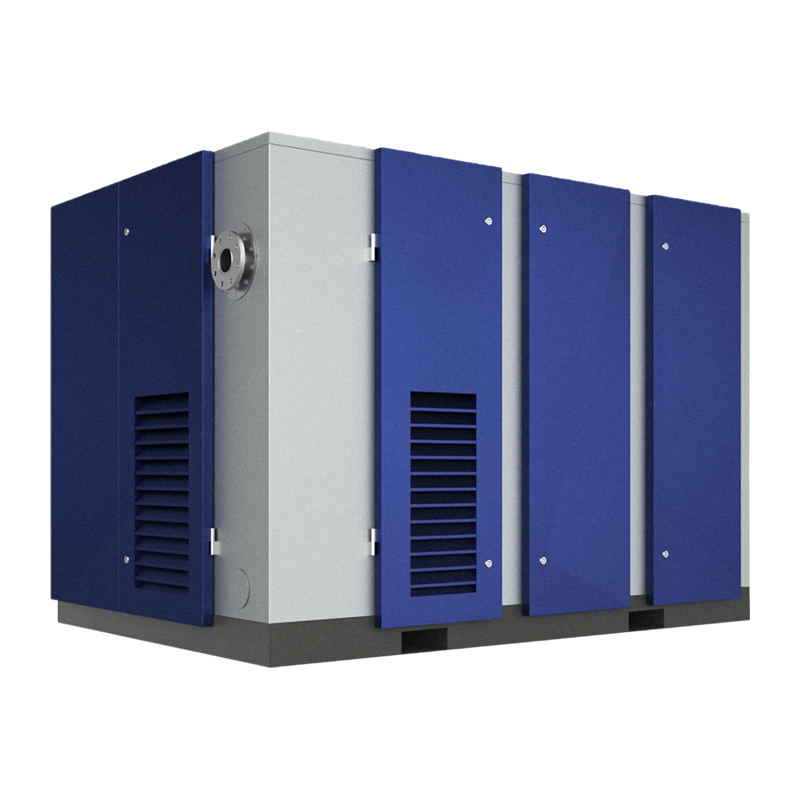 Baiao BHV-Z PM VSD Two-Stage Oil-Injected Screw Air CompressorFor plants where compressed air is a major electrical load, this oil-injected two-stage PM VSD compressor pairs dual variable-frequency control with an integrated airend.View Product →
Oil-Injected or Oil-Free: Match the Air Compressor to the Process, Not the Price Tag
Oil-free rotary screw compressors cost more to buy and more to service, and they are the only defensible choice when compressed air touches food, pharmaceutical product, semiconductor wafers or breathing air.
In an oil-injected machine, oil seals, lubricates and cools the airend, which is why that design is simpler, cheaper and slightly more efficient. A well-maintained separator and coalescing filter bring oil carry-over down to roughly 1 to 5 milligrams per cubic metre, acceptable for pneumatic tools, packaging and general plant air. It is not acceptable on a filling line or in a cleanroom, where every trace of oil becomes a quality deviation.
| Technology | Typical power range | Best-fit duty | Key trade-off |
| Single-stage oil-injected screw | 5-250 kW | Continuous general plant air | Lowest capital cost per m3/min, but dryers and filters are mandatory |
| Two-stage oil-injected screw | 30-500 kW | Continuous, energy-driven projects | Roughly 10-15 percent better specific power than single stage |
| Oil-free screw, dry or water-lubricated | 15-400 kW | Food, pharma, electronics, breathing air | No oil risk, but higher capital cost and higher specific power |
| Piston | 1-75 kW | Intermittent use, high pressure, workshops | Low first cost, high noise and maintenance at continuous duty |
| Centrifugal | 200 kW and above | Steady base load, round-the-clock operation | Superb efficiency in a narrow band, poor turndown without VSD |
ISO 8573-1 is the standard that grades compressed air by particle, water and oil content in three separate classes. Class 0 does not mean zero oil; it means measured oil content below Class 1, verified by testing rather than assumed from the compressor's design.
Oil-free machines reach the same pressure by different routes. Dry screw airends use timing gears and tight clearances instead of oil, and run hotter and faster. Water-lubricated screw compressors use water as the sealing and cooling fluid, so the only liquid in the air path is water. Scroll compressors cover small flows quietly. Baiao's oil-free range spans dry screw, water-lubricated and scroll types, and the model suffixes mark different drive and control configurations.
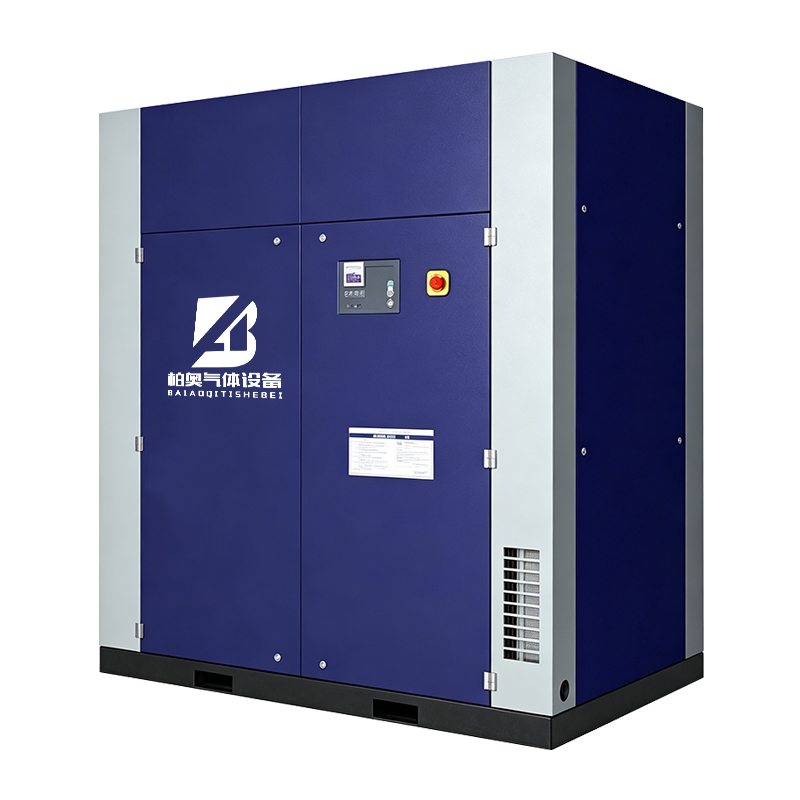
 Baiao BMWV-G PM VSD Oil-Free Water-Lubricated Screw Air CompressorWater-lubricated oil-free rotary screw compressor produces ISO 8573-1 CLASS 0 air for plants needing pure compressed air before downstream drying and filtration.View Product →
Air Treatment Decides Whether Your Air Compressor Is an Asset or a Corrosion Source
An air compressor on its own delivers hot, saturated air. Without a dryer and filters, that moisture condenses in headers, tools and product, and the resulting damage costs far more than the treatment equipment that prevents it.
Every 10 cubic metres per minute of free air at 30 degrees Celsius and 60 percent relative humidity carries roughly 10 litres of water per hour. The aftercooler removes part of it; the rest travels downstream as vapour and condenses wherever the air cools, which is usually inside a tool, a valve or a product. Treatment is therefore sized against a required pressure dew point rather than picked from a catalogue page.
| Dryer type | Pressure dew point | Operating cost driver | Typical use |
| Refrigerated | +3 to +10 | Lowest, small refrigerant load | General plant air, pneumatic tools |
| Membrane | -20 to -40, flow dependent | Purge air loss of roughly 15 to 20 percent | Point-of-use, outdoor lines |
| Heatless desiccant | -40 to -70 | High, purge of 12 to 18 percent of rated flow | Instrument air, critical processes |
| Heated or heat-of-compression desiccant | -40 | Lower purge, higher capital cost | Large continuous flows |
Filters finish the job. A coalescing filter downstream of the dryer removes the remaining aerosol, and a carbon filter removes odour and oil vapour where the process is sensitive. Element condition is measurable: once a filter element costs more than about 0.5 bar of pressure drop, it is consuming more energy than a replacement element costs to buy. In food and beverage production, treatment is not a preference; it is the line item that keeps a product specification defensible.
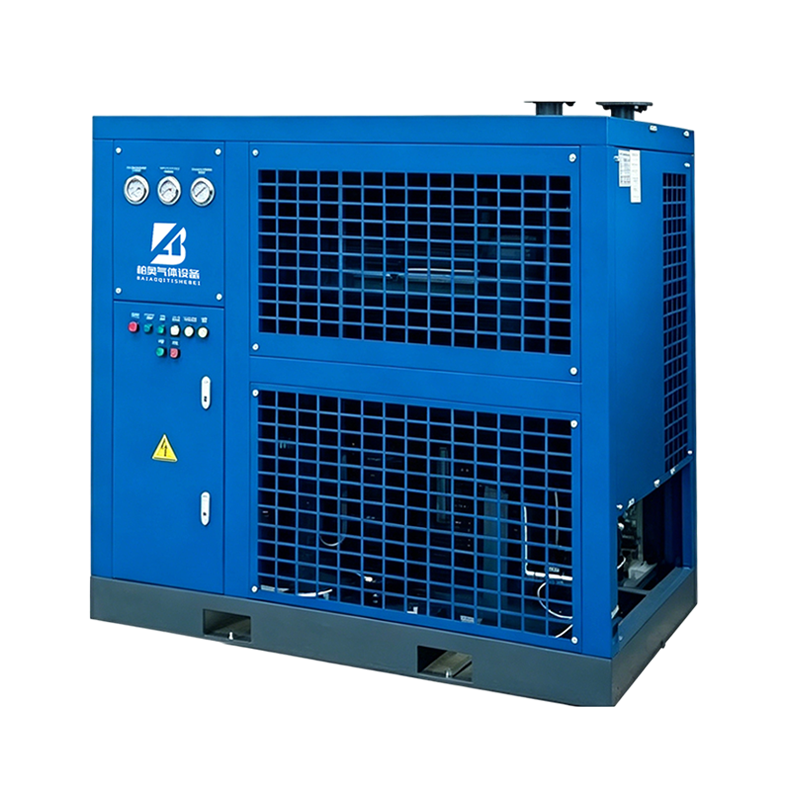 BBL Refrigerated Air Dryer for Compressed Air TreatmentBBL refrigerated air dryer achieves ≤ -23°C dew point, using a gas-liquid separator and powder-coated airflow surfaces for compressed air treatment.View Product →
Sizing an Air Compressor: Five Checks That Change the Final Quote
Correct sizing comes from a measured flow and pressure profile, not from the nameplate of the machine being replaced. Run these five checks in order, and the specification will change before anyone signs it.
- Measure flow before sizing anything. A leak survey on a typical plant finds 20 to 30 percent of output going to leaks. One 1 mm hole at 7 bar bleeds about 1.2 litres per second, roughly 4.3 cubic metres per hour.
- Fix pressure at the point of use, not at the compressor. Set the header for the highest genuine requirement plus line losses, and trim the rest with regulators.
- Reserve 15 to 20 percent headroom. Oversizing costs twice: extra capital, and a machine that spends its life unloaded where specific power is worst.
- Size the receiver and the pipe. One US gallon of receiver volume per cubic foot per minute of output is a practical starting point; undersized piping adds pressure drop no compressor can fix.
- Match the drive to the load profile. Variable speed pays back where demand swings by more than 30 percent for hours at a time. Flat, continuous demand favours fixed speed.
Fixed speed
- Lower capital cost, simpler control
- Best specific power at full load only
- Efficiency falls sharply below 70 percent load
- Right choice for stable, continuous demand
Variable speed
- Holds efficiency from roughly 25 to 100 percent flow
- Adds 15 to 25 percent to the purchase price
- Payback typically inside one to three years
- Needs clean, cool inlet air to stay reliable
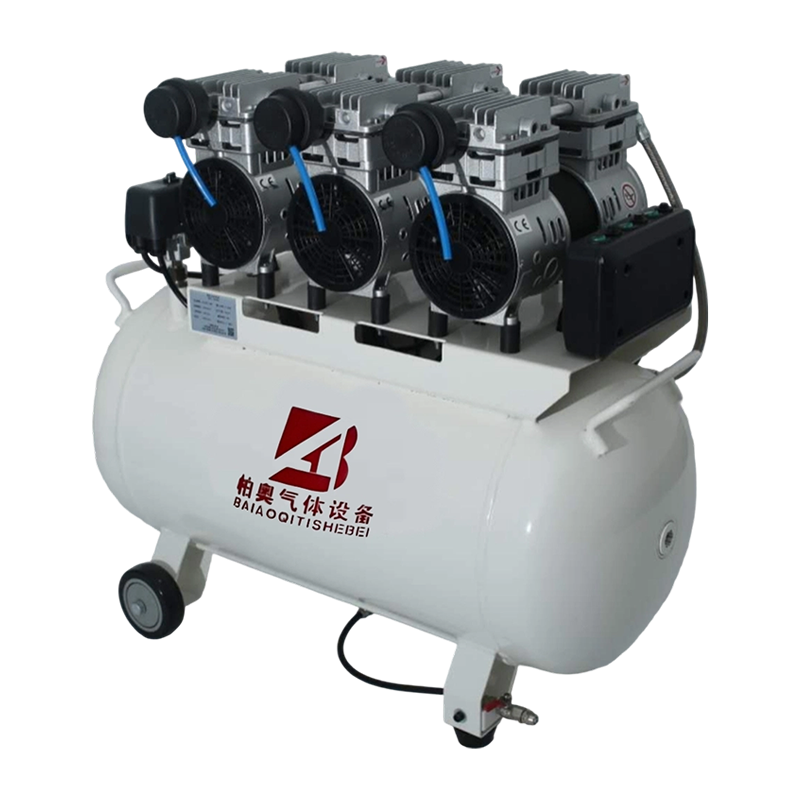
Where demand really is intermittent, such as a two-bay workshop or a mobile service truck, a piston machine that starts and stops a few dozen times a day is still the right answer; the duty patterns behind that choice are set out in this guide to piston-type air compressor applications.
Frequently Asked Questions About Air Compressor Selection
What size air compressor do I need for a small workshop?
Add up the tools that run at the same time. Handheld air tools typically draw 0.1 to 0.5 cubic metres per minute each, a spray gun about 0.3 to 0.5, and a small sandblaster considerably more. Add 20 to 30 percent for leakage and future tools, then choose a machine whose rated flow at your working pressure exceeds that total. Below roughly 1 cubic metre per minute, piston machines dominate; above it, and running daily, a screw compressor is the better investment.
Is a variable-speed air compressor worth the extra cost?
Yes, when the load varies for more than an hour or two a day. A variable-speed drive usually adds 15 to 25 percent to the capital cost and returns it through lower part-load energy, with payback commonly inside one to three years on two-shift operation. If the machine runs at full load all day, a fixed-speed unit is the better buy.
What pressure dew point do I need?
General plant air with indoor piping is fine at a pressure dew point of plus 3 degrees Celsius, which a refrigerated dryer delivers. Outdoor lines, unheated buildings and instrument air need minus 20 to minus 40 degrees, which means a desiccant or membrane dryer. Match the dryer to the coldest point in the system rather than to the compressor room, and avoid overspecifying the dew point because purge air and regeneration energy are continuous costs.
How often should compressor filters and dryers be serviced?
Follow differential pressure rather than the calendar. Coalescing and carbon elements are normally replaced at 2,000 to 4,000 operating hours, or when pressure drop reaches about 0.5 bar, whichever comes first. Check drain traps and automatic condensate valves daily: a stuck trap sends water into the dryer, and a trap stuck open wastes compressed air around the clock.
- Tel: +86-15057127179
+86-13588382771 - Email: huang.yifan0215@gmail.com
- Address: Huanshan Township, Fuyang District, Hangzhou City, Zhejiang Province
Copyright © Zhejiang Baiao Gas Equipment Co., Ltd. All Rights Reserved.
Privacy
Gas Generator Plant Manufacturer, Industrial Purification Equipment Plant
