 en
 русский
 Español
 عربى

Gas Purification for Industrial Compressed Air: Stages, Specs, and Costs
Content
- 1 What Gas Purification Removes From Compressed Air
- 2 The Four Stages of a Purification Train, In Order
- 3 Refrigerated or Desiccant: Choosing a Gas Purification Dryer
- 4 Matching Purity Classes to Food, Electronics, and Petrochemical Duty
- 5 Sizing a Gas Purification Train: What to Fix Before You Issue the PO
- 6 Frequently Asked Questions About Gas Purification
An oil-injected screw compressor running at 7 bar and 35 °C pushes roughly 5 mg of oil aerosol into every cubic metre of air it produces, along with water at full saturation and particulate down to 0.01 micron. Feed that untreated air to a PSA nitrogen generator, a laser cutting head, or a bottling line and the contamination lands exactly where it does the most damage: on the carbon bed, on the optics, inside the package.
Get the sequence right and a four-stage train holds ISO 8573-1 oil Class 1 for years on a modest maintenance budget. Get it wrong and coalescing elements are replaced every quarter while the dew point still drifts above what the process needs. The sections below cover stage order, the dew points each technology actually delivers, and the numbers worth writing into a purchase order.
What Gas Purification Removes From Compressed Air
Gas purification has six contaminant families to handle, and no single device removes all of them. Bulk liquid is separated mechanically, water vapour needs a dryer, oil aerosol needs coalescing filtration, oil vapour and odour need adsorption, solid particulate needs depth filtration, and microorganisms need a sterilizing-grade membrane. Assigning one stage to the wrong family is the most common reason elements fail early.
Particle size decides which stage does the work. Droplets and dust above 0.01 micron are caught by coalescing elements; anything finer travels as vapour and can only be removed by adsorption on activated carbon. That is why the carbon adsorber sits at the end of the train, and why a genuine 0.01 micron element, not a nominal 0.1 micron rating, is the practical target for oil Class 1.
The Four Stages of a Purification Train, In Order
The stage order that works is bulk separation, drying, coalescing filtration, then adsorption polishing. Each stage exists to protect the one behind it, and a stage installed in the wrong position raises operating cost instead of lowering it.
- Bulk separation. A cyclone and an oil-water separator, such as the BFS series, take out free liquid water, oil slugs and pipe scale before they coat an element. Skipping this step is why some sites change coalescing elements every quarter.
- Drying. A refrigerated dryer holds +3 °C pressure dew point with no purge air; a regenerative desiccant dryer reaches -40 °C or lower and spends part of the compressed air flow on regeneration. Choose on required dew point first, energy second.
- Coalescing filtration. Elements rated at 0.01 micron remove the aerosol that survives drying. Efficiency collapses once an element is saturated, so differential pressure, not the calendar, should decide replacement.
- Adsorption polishing. Activated carbon removes oil vapour and odour; for high-purity nitrogen a carbon-supported purifier removes the residual oxygen a PSA generator leaves behind.
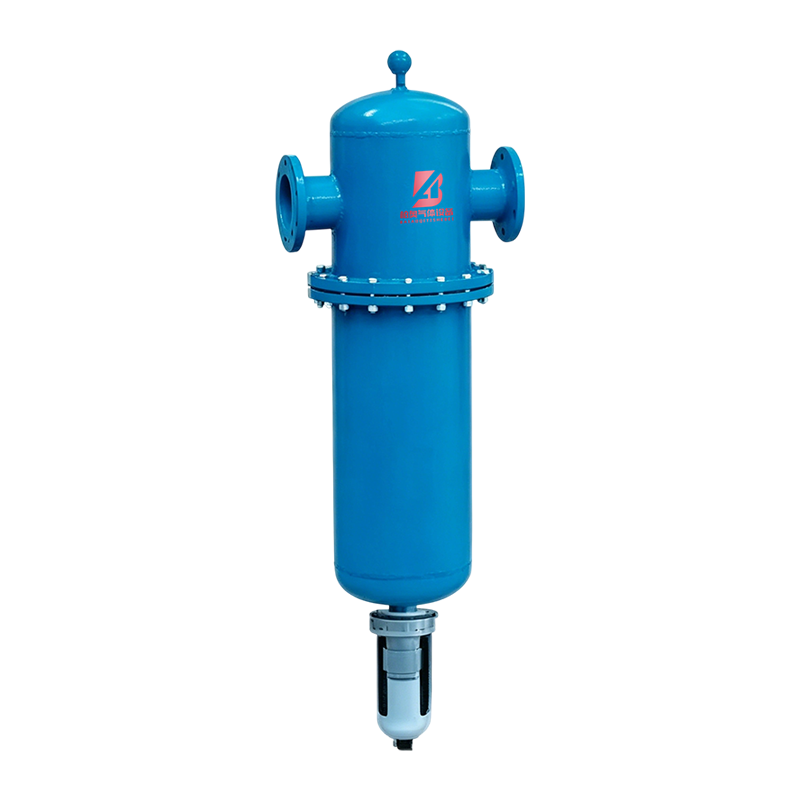 BAF Precision Filter for Compressed Air TreatmentA coalescing filtration option after drying and before adsorption polishing, removing oil, water mist, and dust from compressed air.View Product →
Refrigerated or Desiccant: Choosing a Gas Purification Dryer
Refrigerated drying is the right answer for general plant air, and desiccant drying is the only answer when lines run outdoors or feed a critical process. The dividing line is +3 °C pressure dew point against -40 °C, and what you pay for those extra 43 degrees is regeneration air, not purchase price.
Refrigerated drying
- +3 °C to +10 °C pressure dew point
- No purge loss, roughly 2 to 3% of compressor power
- Condensate needs automatic draining, including in winter
- Fails as soon as the line temperature drops below freezing
Desiccant drying
- -40 °C standard, down to -70 °C in combined designs
- Regeneration air of 4 to 18% of rated flow, depending on type
- Requires downstream filtration to catch desiccant dust
- The only option for outdoor lines and analyser feed
| Dryer type | Pressure dew point | Regeneration loss | Typical duty |
| Refrigerated (BBL) | +3 °C | None | Indoor plant air, general workshop use |
| Heatless regenerative (BAL) | -40 °C | 12 to 18% of flow | Instrument air, small and medium flows |
| Micro-heat regenerative (BEL) | -40 °C | 4 to 8% of flow | Instrument air with a tight purge budget |
| Blower-type thermal (BGD) | -40 °C | Under 1% of flow | Large flows, energy-sensitive sites |
| Combined low dew point (BEA) | -70 °C | 6 to 10% of flow | Critical process, outdoor lines, analyser feed |
Purge loss is where the operating budget actually lives. A heatless dryer on a 100 kW compressor takes about 15% of the flow, which is compressed air that is produced and then thrown away. A blower-type thermal regeneration unit brings that figure below 1% while adding a small heater and blower load, and on large flows the price difference usually pays back within two to three years.
 BGD Blower-type Thermal Regeneration Adsorption DryerConsider this dryer where purge loss drives operating cost, using compressor exhaust heat for desiccant regeneration in a double-tower adsorption system.View Product →
Matching Purity Classes to Food, Electronics, and Petrochemical Duty
Most specifications are wrong in both directions at once: a -70 °C dryer is bought for a warehouse line that needs +3 °C, while the oil class stays at 3 where the process needs Class 1. Match the class to the failure mode, not to the compressor brochure.
| Industry | Water class (dew point) | Oil class | What drives the requirement |
| Food and beverage packaging | Class 2 (-40 °C) | Class 1 (0.01 mg/m3) | Product contact and hygiene audits |
| Electronics and SMT assembly | Class 1 (-70 °C) | Class 1 | Condensation on joints and optics |
| Petrochemical instrument air | Class 2 (-40 °C) | Class 2 (0.1 mg/m3) | Outdoor impulse lines that must not freeze |
| Biopharmaceutical | Class 2 (-40 °C) | Class 0 (specified) | Sterile boundary, sterilizing filter required |
| Metallurgy and laser cutting | Class 2 (-40 °C) | Class 1 | Lens and nozzle protection, clean cut edges |
Hygiene is the driver in food and beverage production, where air that touches product or packaging surfaces is normally held at Class 1 for oil and Class 2 for water. Electronics is driven by condensation, because a 5 °C swing in dew point at an SMT line is enough to form micro-droplets on joints. Petrochemical instrument air is driven by outdoor impulse lines, where a +3 °C dew point freezes on the first cold night of the year.
Nitrogen users face a second problem. A PSA or membrane generator typically delivers 95 to 99.9% nitrogen, and any application needing 99.999% requires a downstream purification step rather than a larger generator.
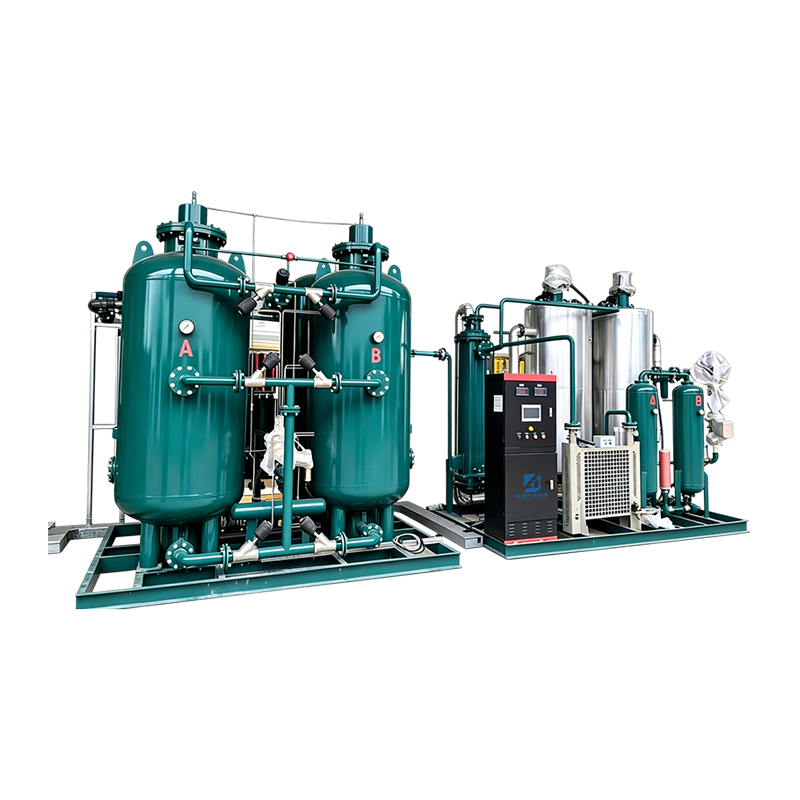 BCN Carbon-Supported Nitrogen Purification for High-Purity NitrogenView this downstream purification step when nitrogen demand exceeds generator purity, removing residual oxygen via carbon catalyst and PSA.View Product →
Sizing a Gas Purification Train: What to Fix Before You Issue the PO
Size the train on summer inlet conditions, never on the compressor nameplate flow. Water load entering a dryer roughly doubles for every 10 °C rise in inlet temperature, so a dryer selected at 25 °C is undersized by half on a 35 °C August afternoon.
Six numbers decide whether the installation works in practice:
- Rated flow at the real inlet temperature and pressure, not only at standard conditions.
- Required pressure dew point plus ISO 8573-1 classes for water, oil and particulate, stated separately.
- Allowable pressure drop across the whole train, normally kept under 0.2 bar when the compressor is already near its limit.
- Purge or regeneration air allowance, expressed as a percentage of compressor output.
- Drain type and freeze protection for outdoor or unheated rooms.
- Spare element sets and the differential pressure at which elements must be changed, written into the service contract.
Pressure drop is the figure most often ignored. A train of separator, dryer, two filters and an adsorber easily reaches 0.3 bar when every element is selected at the top of its flow range, and that extra discharge pressure costs more energy over a year than the filters themselves.
Frequently Asked Questions About Gas Purification
What pressure dew point does instrument air need?
Instrument air is normally specified at -40 °C pressure dew point, which is ISO 8573-1 water Class 2, with oil at Class 1 or Class 2 depending on valve and actuator type. Lines that run outdoors or through unheated spaces are pushed to -70 °C, water Class 1, because a +3 °C dew point freezes and blocks impulse lines on the first cold night.
Can a refrigerated dryer replace a desiccant dryer?
No. A refrigerated dryer is limited by its refrigerant circuit to roughly +3 °C pressure dew point and cannot dry air below freezing point, while a regenerative desiccant dryer reaches -40 °C. Refrigerated drying suits indoor plant air; desiccant drying is required whenever the line is exposed to sub-zero ambient temperatures or the process demands a stable low dew point.
How often should purification filter elements be changed?
Replace coalescing and carbon elements when differential pressure reaches roughly 0.7 to 1.0 bar above the clean value, which in a typical 7 bar plant air system means every 6 to 12 months. Calendar replacement is a fallback for sites without gauges, and it usually wastes elements on clean systems while missing saturated ones on dirty systems.
Is an oil-free compressor enough to guarantee clean air?
No. An oil-free compressor removes the oil it would otherwise inject, but ambient intake air still carries 0.01 to 0.1 mg of hydrocarbon vapour per cubic metre, plus water at full saturation and particulate. Oil-free air still needs a dryer and filtration, and oil vapour is only removed in an activated carbon adsorber.
- Tel: +86-15057127179
+86-13588382771 - Email: huang.yifan0215@gmail.com
- Address: Huanshan Township, Fuyang District, Hangzhou City, Zhejiang Province
Copyright © Zhejiang Baiao Gas Equipment Co., Ltd. All Rights Reserved.
Privacy
Gas Generator Plant Manufacturer, Industrial Purification Equipment Plant
