 en
 русский
 Español
 عربى

Nitrogen Generator for Food Packaging: A Purity, Cost, and Sizing Guide
Content
- 1 What Purity of Nitrogen Does a Food Packaging Line Actually Need?
- 2 PSA or Membrane Separation: Which Nitrogen Generator Fits a Packaging Hall?
- 3 The Cost Math: Cylinders, Liquid Dewars or On-Site Generation
- 4 Food-Grade Nitrogen: The Feed-Air Requirement Most Buyers Underestimate
- 5 Sizing and Commissioning: Five Steps From Flow Rate to Start-Up
- 6 Frequently Asked Questions
A six-head vertical form-fill-seal line running at 80 packs per minute consumes roughly 8 to 15 Nm3/h of nitrogen, and the seal head stops the moment the gas supply does. That single dependency is why snack, bakery and ready-meal plants eventually move away from delivered liquid nitrogen toward an on-site nitrogen generator for food packaging.
Modified atmosphere packaging (MAP) replaces the air inside a sealed pack with a controlled gas mixture. Nitrogen acts as the inert filler gas that displaces oxygen, carbon dioxide suppresses microbial growth, and a small amount of oxygen is sometimes added back to keep red meat looking fresh.
The engineering question is rarely whether nitrogen works. It is what purity, flow rate and feed-air quality a specific packaging hall needs, and whether the equipment can hold that specification through a full production week without drift.
Buyers who skip the demand mapping step tend to oversize their nitrogen generator for food packaging system by 40% or more, paying for separation capacity the line never uses and for compressed air that is produced, dried and then vented to atmosphere.
What Purity of Nitrogen Does a Food Packaging Line Actually Need?
Most food packaging lines run nitrogen at 99.5% to 99.9% purity, which holds residual oxygen inside the sealed pack between 0.5% and 2.0%. Purity above 99.9% is normally reserved for high-fat, high-value or long-shelf-life products, where the cost of one rejected batch outweighs the cost of the gas.
The commercially meaningful number is residual oxygen, not generator purity. Oxygen drives the three failures that shorten shelf life: lipid oxidation and rancidity, mould and aerobic bacterial growth, and colour or aroma degradation. Headspace oxygen above 2% typically halves achievable shelf life on oxygen-sensitive products such as roasted nuts and potato chips.
| Potato chips and extruded snacks | 1.0% to 2.0% | 99.5% | High fat content, fast rancidity |
| Roasted nuts and ground coffee | 1.0% to 2.0% | 99.5% | Aroma and oil retention |
| Bakery, tortillas and pita | 0.5% to 1.0% | 99.9% | Mould control over long distribution |
| Hard and sliced cheese | 0.5% to 1.0% | 99.9% | Mould and rind spoilage |
| Sliced cooked meats | 0.5% to 1.0% | 99.9% | Blended with 20% to 30% CO2 |
| Ready meals and fresh pasta | 1.0% to 2.0% | 99.5% to 99.9% | Prevents pack collapse in transit |
A 0.1% improvement in purity is never free. Each additional nine on the specification increases the amount of adsorbent or membrane area required, and therefore the compressed air consumption standing behind the generator.
Purity, flow and pressure are one specification, not three
A generator rated at 99.9% at 10 Nm3/h will not deliver 99.9% at 25 Nm3/h. Purity is a function of flow, pressure and installed separation area, so the specification must be written as a single operating point: purity at a stated flow, at a stated pressure, at a stated inlet temperature.
Plants that quote a headline purity figure without quoting the conditions behind it are making a claim that cannot be verified at commissioning, and that is where most warranty disputes begin.
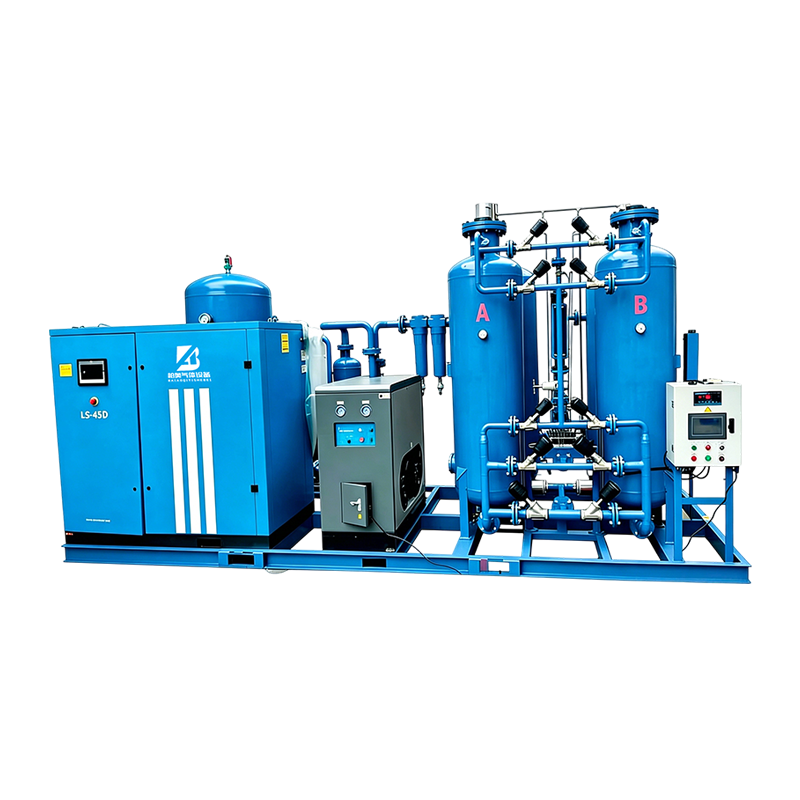
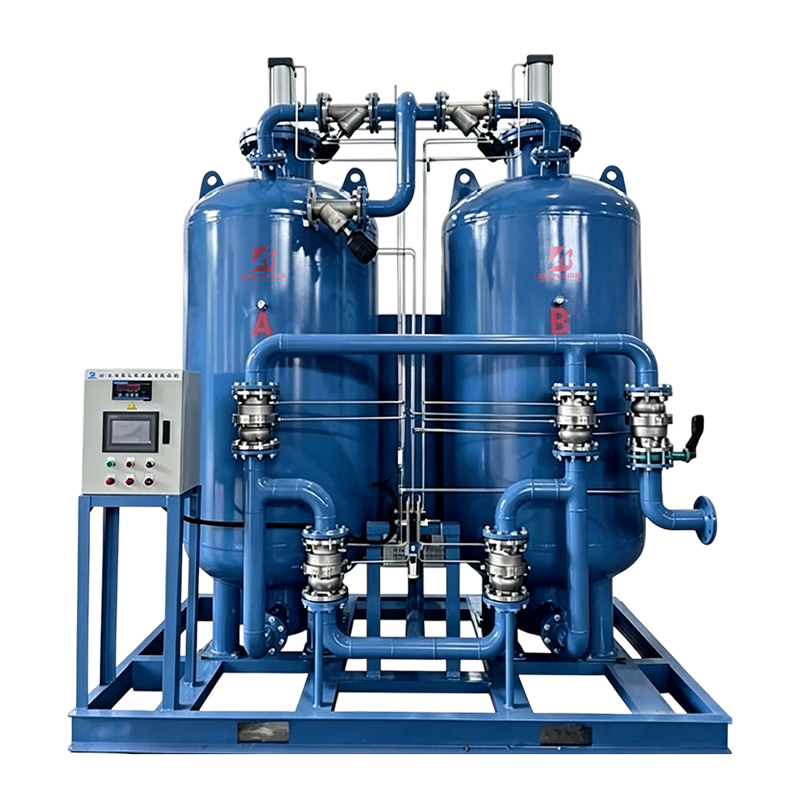 BAN PSA Nitrogen Generator with Carbon Molecular Sieve SeparationFor lines needing 99.9% or higher purity at flows near 200 Nm3/h, this PSA nitrogen generator uses carbon molecular sieves.View Product →
PSA or Membrane Separation: Which Nitrogen Generator Fits a Packaging Hall?
PSA is the right choice when a line needs 99.9% or higher purity at flows up to roughly 200 Nm3/h, while membrane separation wins when a plant needs large volumes of 95% to 99.5% nitrogen with minimal maintenance. The two technologies are not interchangeable, and the decision usually comes down to the purity the product genuinely requires.
Pressure swing adsorption (PSA)
- Purity range: 99.0% to 99.999%
- Typical flow: 1 to 200 Nm3/h per skid
- Footprint: larger, carbon molecular sieve vessels
- Maintenance: switching valves plus scheduled sieve replacement
- Best fit: bakery, cheese, sliced meat and long-life packs
- Start-up: 10 to 20 minutes to stable purity
Membrane separation
- Purity range: 95% to 99.5%
- Typical flow: 5 to 500 Nm3/h
- Footprint: compact skid, no switching valves
- Maintenance: prefiltration and eventual membrane replacement
- Best fit: snacks, produce and high-volume flushing at 98%
- Start-up: 2 to 5 minutes to stable purity
Membrane systems have no moving parts in the separation path, which matters in a hall running three shifts where a valve failure at 2 a.m. stops the packaging line until an engineer arrives. Adsorption systems deliver higher purity but concentrate their risk in valve and control reliability, so solenoid quality and sieve bed life become the deciding factors over a ten-year horizon.
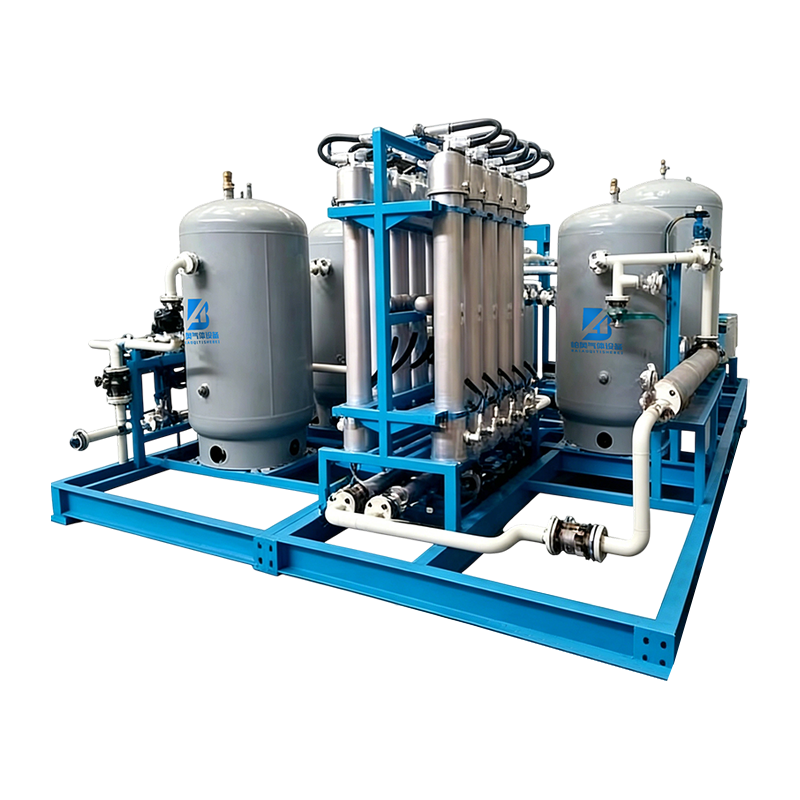 BAM Membrane Nitrogen Generator for On-Site Industrial Gas SupplyFor plants drawing 20-40 Nm3/h, this membrane system offers on-site nitrogen generation with no moving parts in the separation path and purity up to 99.9%.View Product →
The Cost Math: Cylinders, Liquid Dewars or On-Site Generation
For a line drawing 20 to 40 Nm3/h, on-site generation typically reduces the cost of nitrogen by 50% to 70% against delivered liquid, with equipment payback falling between 12 and 24 months.
Delivered gas carries costs that never appear on the invoice: cylinder rental, dewar demurrage, residual losses during changeover, and the labour hours spent moving, connecting and leak-testing vessels. On-site generation converts most of that spend into electricity and scheduled maintenance, both of which are predictable.
Relative cost per unit of nitrogen, cylinder supply indexed at 100
Food-Grade Nitrogen: The Feed-Air Requirement Most Buyers Underestimate
Nitrogen that contacts food must be produced from oil-free compressed air and filtered to ISO 8573-1 Class 1 for oil and particles. The generator controls purity; the air treatment upstream controls whether that purity is food-safe.
A separation module or a carbon molecular sieve bed removes oxygen from air. It does not remove compressor oil, water or microbial contamination. If a lubricated compressor sits at the front of the system, oil aerosol travels through the separation stage and ends up in the headspace of the pack, where it becomes a sensory and food-safety problem that no purity certificate can offset.
A food-grade installation normally includes the following stages, in this order:
- Oil-free compression, specified as ISO 8573-1 Class 0 or Class 1 for oil.
- Drying to a pressure dew point of -40 C or lower, using refrigerated or desiccant equipment.
- Coalescing and precision filtration down to 0.01 micron for particles and aerosol.
- Activated carbon filtration to remove taste and odour carryover.
- Sterile filtration at the point of use, downstream of the generator and close to the packaging machine.
The generator sets the purity. The air treatment upstream sets whether that purity is food-safe.
Verification matters as much as hardware. A commissioning report should record nitrogen purity, residual oxygen in a sample pack, pressure dew point and oil content, and those readings should be repeated at every annual service so there is a traceable record for audits.
 BFJ Sterilizing Filter for Sterile Compressed Air SystemsFor sterile compressed air in pharmaceutical, fermentation, and food/beverage processes, this hydrophobic PTFE filter supports gas purification where commissioning verification matters.View Product →
Sizing and Commissioning: Five Steps From Flow Rate to Start-Up
Size the generator on peak demand plus 20%, never on average consumption. Peak demand is set by the number of fill heads, the pack volume and the flush time, and it is the number that decides whether the seal head ever starves.
- Measure peak nitrogen demand in Nm3/h. Count fill heads, pack volume, line speed and flush time, then add 20% headroom for the next line speed increase.
- Fix purity and delivery pressure together. Packaging machines usually need 4 to 6 bar at the nozzle, and a generator that reaches its purity only at 7 bar will underperform on the line.
- Size buffer storage. A receiver holding 30 to 60 seconds of demand smooths the surge created when several fill heads open at the same moment.
- Plan redundancy and maintenance access. Duplex skids, or a single unit with a scheduled spare sieve bed, keep the hall running during service.
- Validate with pack testing. Measure residual oxygen at start-up, mid-shift and after the longest stoppage, not only on a freshly serviced machine.
Talk to the engineering team about your nitrogen generator for food packaging project with line speed, pack volume and hygiene layout in hand, and ask for a sizing calculation before approving the purchase order.
Frequently Asked Questions
What purity of nitrogen do I need for food packaging?
Most snack, bakery and cheese applications are well served by 99.5% to 99.9% nitrogen, which holds headspace oxygen between 0.5% and 2.0%. Products with long distribution windows or high fat content usually justify 99.9%, while short-shelf-life products rarely need more than 99.5%.
Can one generator supply several packaging lines?
Yes, provided the generator is sized on the sum of peak demands rather than average demand and a receiver is installed to absorb simultaneous flushes. Single-generator supply is standard practice up to a few hundred Nm3/h; beyond that, plants usually split the load across two skids to limit the impact of a single stoppage.
How much maintenance does an on-site nitrogen generator need?
PSA systems require periodic replacement of coalescing and carbon filters, inspection of switching valves and, at the end of their service life, replacement of the carbon molecular sieve. Membrane systems have no switching valves in the separation path and typically need only prefiltration and eventual membrane replacement.
Is on-site nitrogen cheaper than buying liquid nitrogen?
Above roughly 10 Nm3/h of consumption, on-site generation is usually cheaper, with typical savings of 50% to 70% against delivered liquid and payback between 12 and 24 months. Below that threshold, delivered gas often stays the lower-cost option because the equipment cost cannot be amortised over enough volume.
- Tel: +86-15057127179
+86-13588382771 - Email: huang.yifan0215@gmail.com
- Address: Huanshan Township, Fuyang District, Hangzhou City, Zhejiang Province
Copyright © Zhejiang Baiao Gas Equipment Co., Ltd. All Rights Reserved.
Privacy
Gas Generator Plant Manufacturer, Industrial Purification Equipment Plant
