 en
en русский
 Español
 عربى
عربى
How to Choose the Right Industrial Air Compressor: Specs, Types, and Total Cost
Content
- 1 Start with Real Air Demand, Not the Price Tag
- 2 Match the Compressor Technology to Your Duty Cycle
- 3 Oil-Free vs Oil-Injected: Define the Air Purity Class First
- 4 Air Treatment: The Compressor Is Only Part of the System
- 5 Total Cost of Ownership: Energy, Maintenance, and Installation
- 6 A Practical Checklist Before You Buy
Start with Real Air Demand, Not the Price Tag
Most air compressor selection mistakes happen before the compressor is even chosen. Buyers compare horsepower and tank size, only to discover that the machine cannot hold pressure when several tools run at the same time. The faster way to avoid that result is to define the load first: the flow, the pressure, and the running pattern of everything the compressor will supply.
Motor power is an input, not an output. Two compressors with the same motor can deliver completely different flows because the airend design, cooling system, and internal losses differ. Always compare flow at a stated pressure, not the motor rating alone.
Flow: CFM and SCFM
The flow rating tells you how much air the compressor can deliver. CFM (cubic feet per minute) is the common unit, while SCFM (standard cubic feet per minute) refers to air at a standardized temperature and pressure. SCFM is a more reliable comparison point because it is not affected by site conditions.
Add up the average air consumption of all tools and machines, then apply a diversity factor if they do not run simultaneously. For continuous processes, choose a compressor with 10-20 percent extra capacity; for intermittent use, a smaller machine with a properly sized receiver tank may be enough.
Pressure: PSI and bar
Every application has a design pressure. A packaging line might need 6-7 bar (87-101 psi), while sandblasting may require 10 bar or more. Remember that piping, filters, dryers, and regulators all create pressure drop. The compressor must deliver enough pressure at the point of use, not just at the discharge flange.
Duty cycle and storage
The duty cycle describes how long a compressor can run before it must rest or reduce load. Reciprocating piston compressors often have a 60-70 percent duty cycle. Rotary screw compressors can normally run continuously. The receiver tank does not create flow; it only smooths peaks and reduces short-cycling.
The table below shows how typical industrial applications align with common compressor selection profiles.
| Application | Typical pressure | Flow profile | Common preference |
|---|---|---|---|
| Automotive assembly | 6-7 bar | Continuous, tools and automation | Oil-injected rotary screw |
| Food and beverage processing | 6-8 bar | Continuous, some oil-free points | Oil-free rotary screw with dryers |
| Electronics manufacturing | 6-7 bar | Steady, low contamination | Oil-free rotary screw with filtration |
| Petrochemical plants | 7-10 bar | Continuous, high availability | Rotary screw or medium-pressure piston |
Match the Compressor Technology to Your Duty Cycle
Once the demand is clear, the next question is which compressor technology can deliver it reliably. Two families cover most industrial needs: reciprocating piston compressors and rotary screw compressors.
| Consideration | Reciprocating piston | Rotary screw |
|---|---|---|
| Continuous running | Limited by heat and valve wear | Designed for continuous duty |
| Output stability | Pulsating flow | Smooth, steady flow |
| Maintenance | Frequent valve, ring, and belt service | Oil, filter, and separator changes |
| Noise and vibration | Higher vibration and noise | Quieter, usually enclosed |
| Typical capacity range | Small to medium, often below 30 kW | Medium to large, including 100 kW+ |
If your plant runs one or two shifts and the air demand is fairly steady, a rotary screw compressor is almost always the more cost-effective choice. Piston machines can still be useful for small repair shops, intermittent blasting, or remote construction, but their pulsating output and frequent service become a problem in production lines.
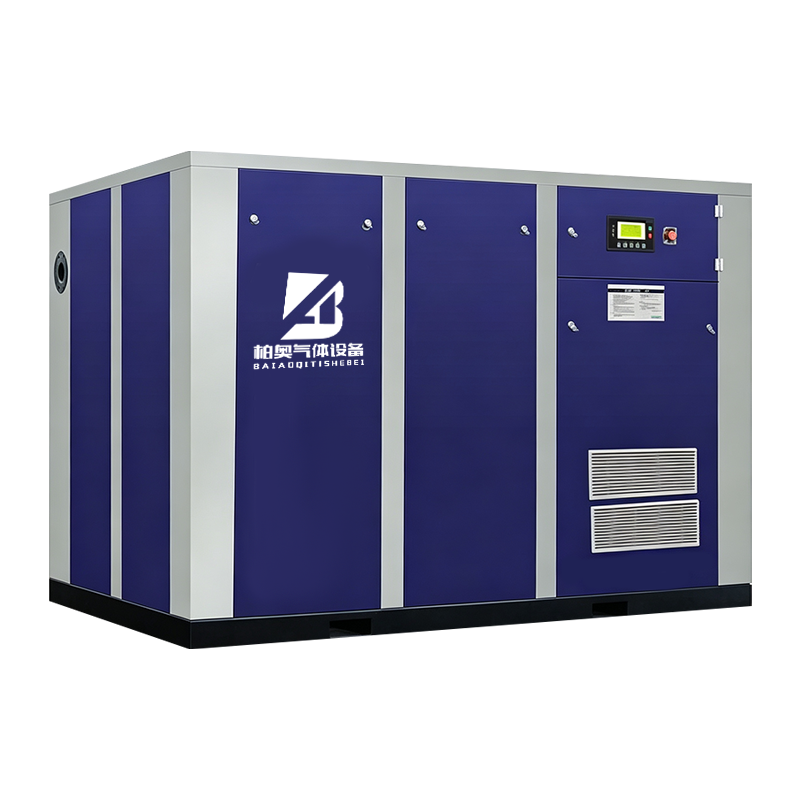
Within the rotary screw family, the next decision is oil-free or oil-injected. For processes where oil contamination is unacceptable, our dry oil-free rotary screw air compressors use non-contact rotors and sealing technology to keep the compression chamber completely free of oil.
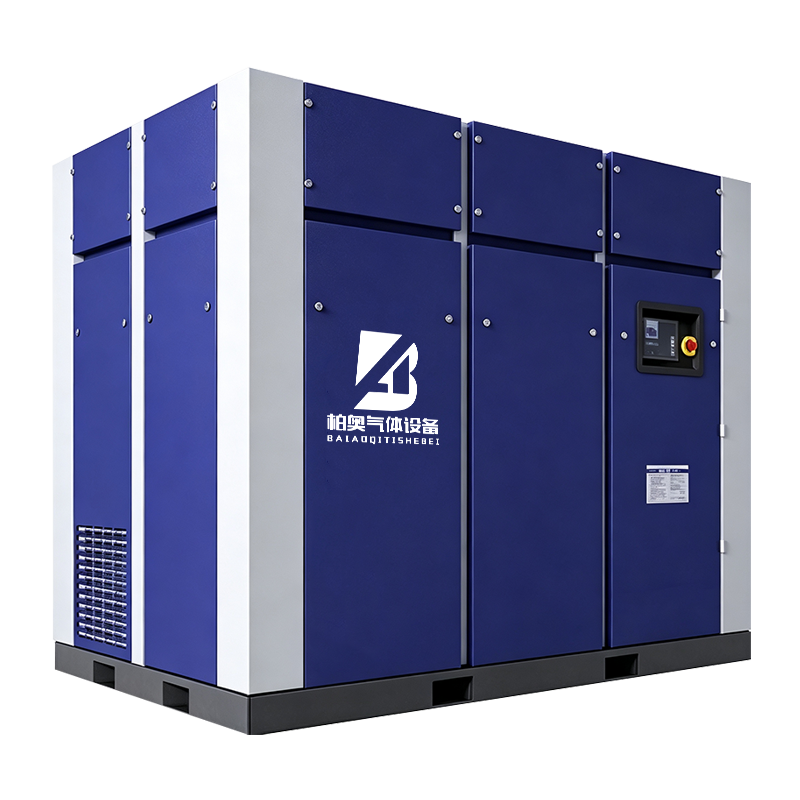 Dry Oil-Free Rotary Screw Air Compressor (PM VSD/FSD) Manufacturer, ExporterZhejiang Baiao Gas Equipment Co., Ltd is China wholesale Dry Oil-Free Rotary Screw Air Compressor (PM VSD/FSD) Manufacturer and Exporter....View Product →
For general plant air, an oil-injected design is often more forgiving and less expensive to purchase. A single-stage oil-injected rotary screw air compressor can handle typical industrial loads with good efficiency, compact packaging, and routine maintenance that maintenance crews already know well.
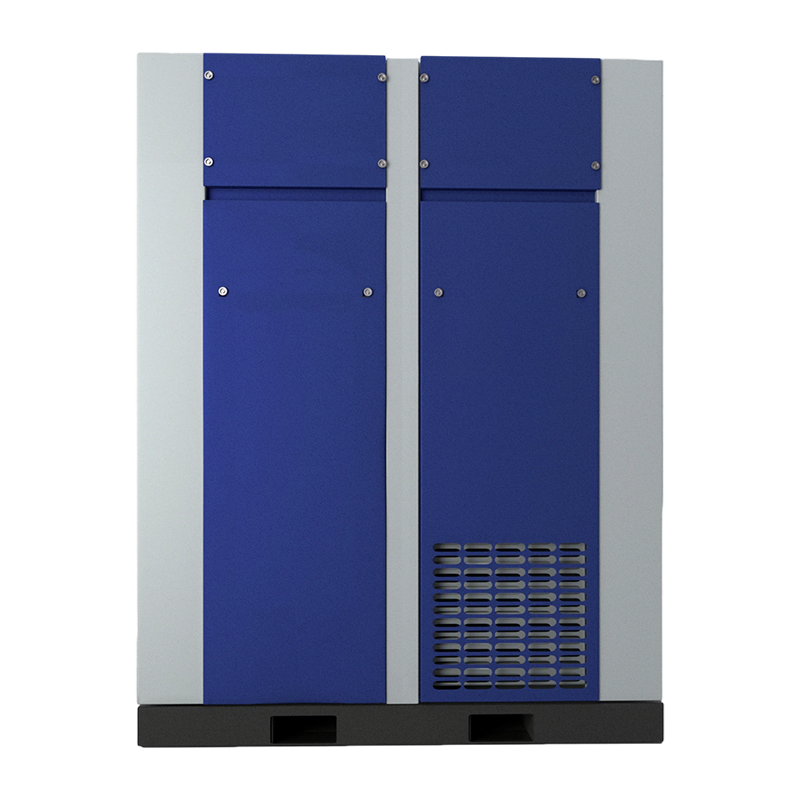 Single-Stage Compression Rotary Screw Air Compressor (PM VSD/FSD) Manufacturer, Zhejiang Baiao Gas Equipment Co., Ltd is China wholesale Single-Stage Compression Rotary Screw Air Compressor (PM VSD/FSD) Manufacturer a...View Product →
Oil-Free vs Oil-Injected: Define the Air Purity Class First
Oil-injected compressors use oil for lubrication, sealing, and cooling. If a downstream process cannot tolerate even trace oil, you have to add filtration, select an oil-free machine, or do both. The ISO 8573-1 standard classifies compressed air purity by particle, water, and oil content. A Class 1 oil requirement normally leads to oil-free compression; Class 3 or 4 processes can often manage with oil-injected compression plus coalescing filters.
Air purity needs vary by industry. Automotive paint shops can use oil-injected compressors with high-grade filtration, but they must monitor oil carryover carefully because a single paint defect can stop a line. Food and beverage lines often favor oil-free compression when air contacts the product or packaging, because the risk of contamination is lower. Petrochemical processes place more weight on reliability and may choose a continuous-duty rotary screw package with redundant filters and dryers.
Oil-free does not mean maintenance-free. The latest oil-free rotary screw designs still need scheduled overhauls, and the intake air filter must be changed regularly. The benefit is lower oil carryover, which simplifies compliance in regulated industries.
General plant air
For maintenance shops, equipment rooms, and general pneumatic tools, oil-injected compression with a coalescing filter is usually enough. It is also easier to service in remote locations because oil and filter elements are widely available.
Sensitive production air
For electronics, pharmaceuticals, food safety, and high-end coating, choose oil-free compression and monitor the dew point. Even then, the compressor is only one part of the air treatment chain.
Air Treatment: The Compressor Is Only Part of the System
Compressed air always contains water vapor from ambient air, even if the compressor is oil-free. As the air cools in the piping, vapor condenses and can cause corrosion, tool damage, and product defects. A dryer between the receiver and the distribution lines removes that moisture.
For most industrial plants, a refrigerated air dryer is the simplest way to reach a stable pressure dew point of 3-10 degrees C. If the piping runs outdoors in winter, or the process needs very dry air, a desiccant dryer can achieve dew points below -20 degrees C. Filters handle particles and oil aerosols; some processes also need sterilizing filters.
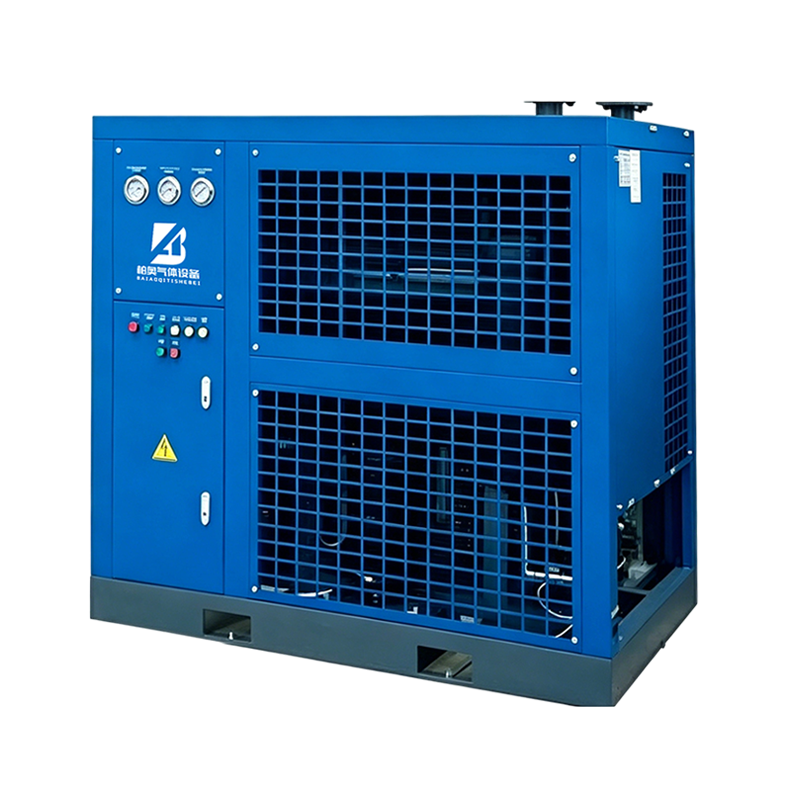 BBL Refrigerated Air Dryer Manufacturer , SuppliersZhejiang Baiao Gas Equipment Co., Ltd is China Custom BBL Refrigerated Air Dryer Manufacturer and Supplier.View Product →
The cost of air treatment is small compared with the damage caused by wet or dirty air. A compressed air system without a dryer often shows up in failed pneumatic cylinders, clogged nozzles, and inconsistent process control. Include the dryer and filter package in the initial budget, not as an afterthought.
Total Cost of Ownership: Energy, Maintenance, and Installation
The purchase price is a small fraction of what a compressor costs over its life. Energy consumption usually accounts for 70-80 percent of the total operating cost. Specific power expresses how many kilowatts are needed to produce each unit of airflow; lower is better. A small difference in specific power can mean thousands of dollars in electricity every year.
Variable speed drive (VSD) compressors are worth considering when air demand fluctuates. They adjust motor speed to the actual load and can cut part-load energy use significantly. Fixed-speed compressors are simpler but may waste energy if they run loaded/unloaded cycles for most of the day.
Pressure settings also matter. Raising the discharge pressure by 1 bar increases energy consumption by roughly 6-7 percent. Do not set the pressure higher than the process needs; fix pressure drops in piping instead of compensating with a higher setpoint.
- Energy: estimate annual running hours, load factor, and electricity price before comparing quotes.
- Maintenance: compare oil, separator, filter, and overhaul intervals for each candidate model.
- Installation: allow enough clearance around the package for cooling airflow and service access.
- Noise: compare dB(A) levels if operators work near the compressor room.
A Practical Checklist Before You Buy
Once the demand and air quality requirements are clear, the selection process becomes straightforward.
- Calculate the peak and average flow in SCFM or m3/min, including future expansion.
- Define the required pressure at the point of use, not just at the compressor outlet.
- Decide between oil-free and oil-injected compression based on ISO 8573-1 classes.
- Select a compressor whose duty cycle matches your running pattern.
- Plan for drying and filtration from the start, not after the first freeze-up.
- Compare energy consumption and maintenance intervals, not only the initial price.
An industrial air compressor that is sized correctly and supported by experienced engineers can run for decades. Start with the duty, set the air quality target, and let those parameters drive the choice of compressor and treatment equipment. Talk to a supplier who understands your application details before committing to a machine.
- Tel: +86-15057127179
+86-13588382771 - Email: huang.yifan0215@gmail.com
- Address: Huanshan Township, Fuyang District, Hangzhou City, Zhejiang Province
Copyright © Zhejiang Baiao Gas Equipment Co., Ltd. All Rights Reserved.
Privacy
Gas Generator Plant Manufacturer, Industrial Purification Equipment Plant
