 en
en русский
 Español
 عربى
عربى
Screw Air Compressor: How Rotary Screw Compressors Work and How to Choose
Content
- 1 Why Continuous Plants Choose the Rotary Screw Design
- 2 How a Rotary Screw Air Compressor Works
- 3 Oil-Injected or Oil-Free: The First Decision
- 4 Fixed Speed, Variable Speed, or Permanent Magnet
- 5 Selection Checks That Prevent Expensive Mistakes
- 6 Matching the Compressor to the Process
- 7 A Final Word on Specification Discipline
Why Continuous Plants Choose the Rotary Screw Design
A maintenance supervisor running a 15 kW piston compressor on a three-shift production line knows the pattern: duty-cycle limits, rising discharge temperatures before the end of the shift, oil carryover into the filter, and service intervals counted in weeks rather than months. Move the same plant onto a rotary screw air compressor, and most of those problems disappear. For continuous or semi-continuous compressed air demand, the rotary screw design is the standard engineering answer.
It supplies air in a steady, pulsation-free stream, runs for years between major overhauls, and in the 5.5-250 kW range where most factories operate it delivers the lowest cost per cubic meter of air. For short, intermittent duty, a piston-type air compressor can still be the right tool; once demand runs more than a few hours a day, the screw design wins on reliability, efficiency and noise. This article explains how a screw compressor works, where oil-injected and oil-free designs differ, and which specification choices prevent costly mistakes.
How a Rotary Screw Air Compressor Works
The Twin-Rotor Compression Cycle
Inside the airend, a male and a female helical rotor rotate in opposite directions within a close-fitting housing. Air enters at the suction port and is trapped in the spaces between the rotor flutes and the housing bore. As the rotors turn, those spaces shrink, the trapped air is compressed steadily, and the high-pressure air is delivered through the discharge port. Because compression is continuous rather than reciprocating, the flow has no pulsation and the machine vibrates far less than a piston compressor of similar capacity.
The Systems Around the Airend
A screw compressor package is more than the airend. It includes the drive motor, a belt or direct transmission, an inlet filter, an intake valve, the oil circuit with its separator and cooler, a minimum pressure valve, an aftercooler with condensate drain, and a controller that manages load, unload and protection functions. In oil-injected machines, the oil circuit is what makes the design practical: injected oil seals the clearances between the rotors, absorbs compression heat, lubricates the moving parts, and is then separated from the air before the discharge leaves the package.
Oil-Injected or Oil-Free: The First Decision
The first question in any screw compressor selection is air purity. An oil-injected rotary screw air compressor is the more affordable, more compact and usually more energy-efficient option for ordinary plant air. Even after the internal air-oil separator, its discharge still contains roughly 1-3 mg/m³ of residual oil; adding coalescing filtration brings that down to ISO 8573-1 Class 1 or Class 2 levels.
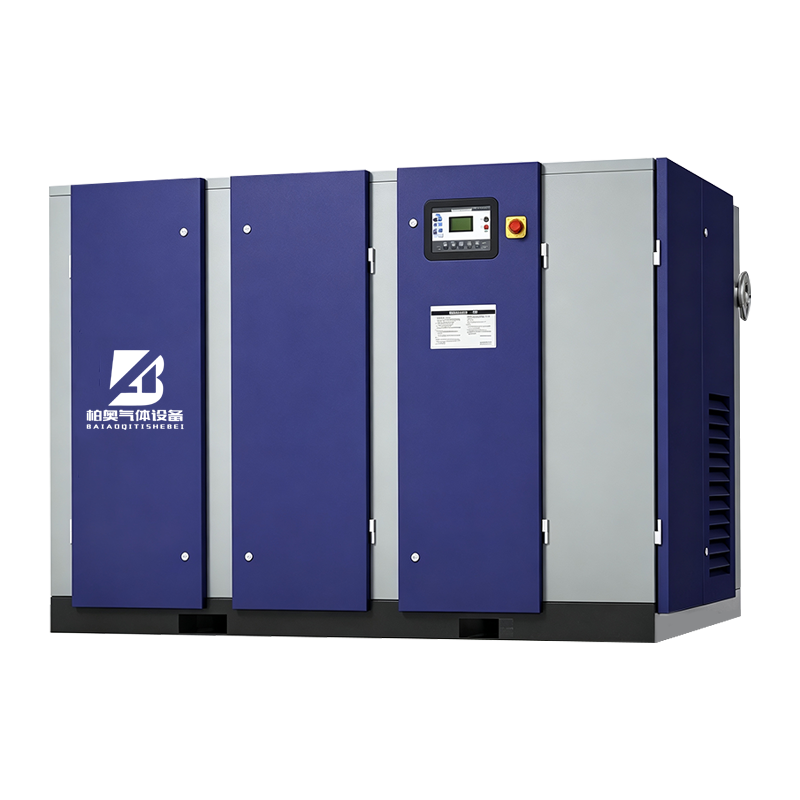
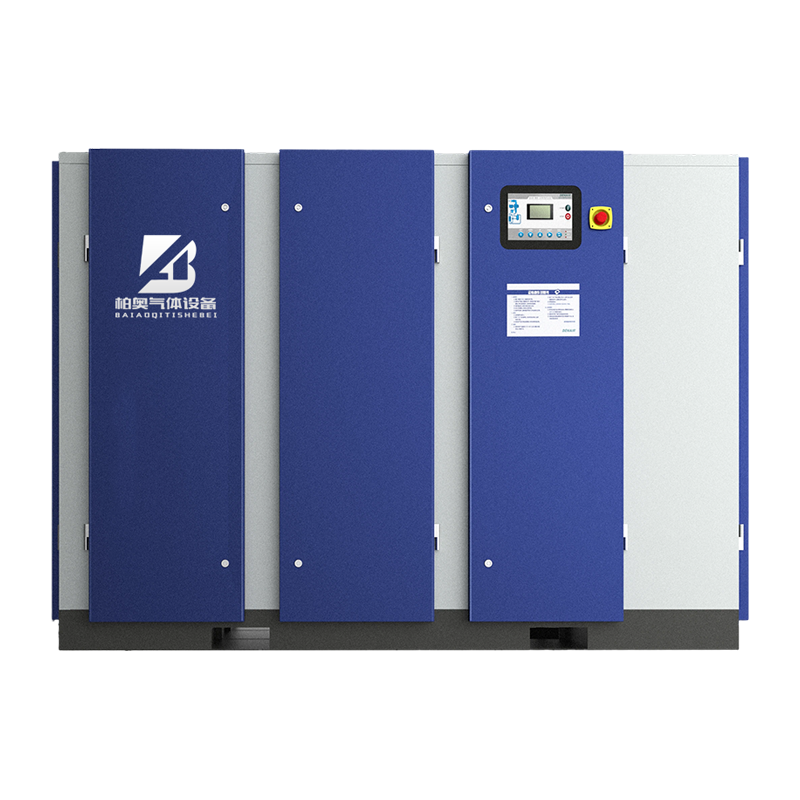
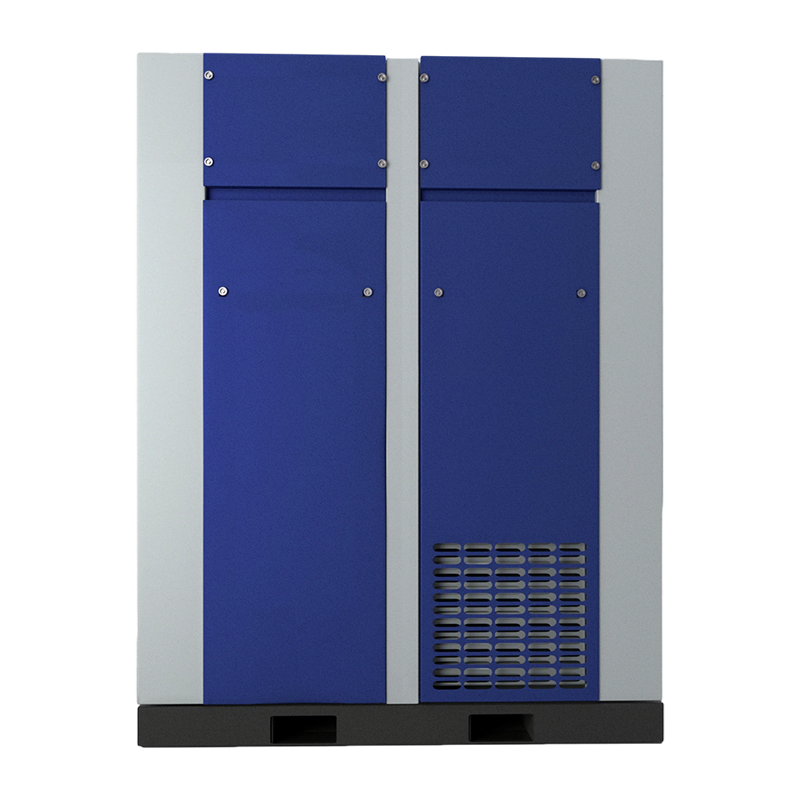 Single-Stage Compression Rotary Screw Air Compressor (PM VSD/FSD) Manufacturer, Zhejiang Baiao Gas Equipment Co., Ltd is China wholesale Single-Stage Compression Rotary Screw Air Compressor (PM VSD/FSD) Manufacturer a...View Product →
An oil-free rotary screw air compressor keeps oil entirely out of the compression chamber. In the dry design, timing gears synchronize the two rotors so that metal never touches metal, and the delivered air meets ISO 8573-1 Class 0 or Class 1 for oil by design. The price of that purity is a higher first cost, a more demanding service schedule, and slightly higher specific power at many operating points.
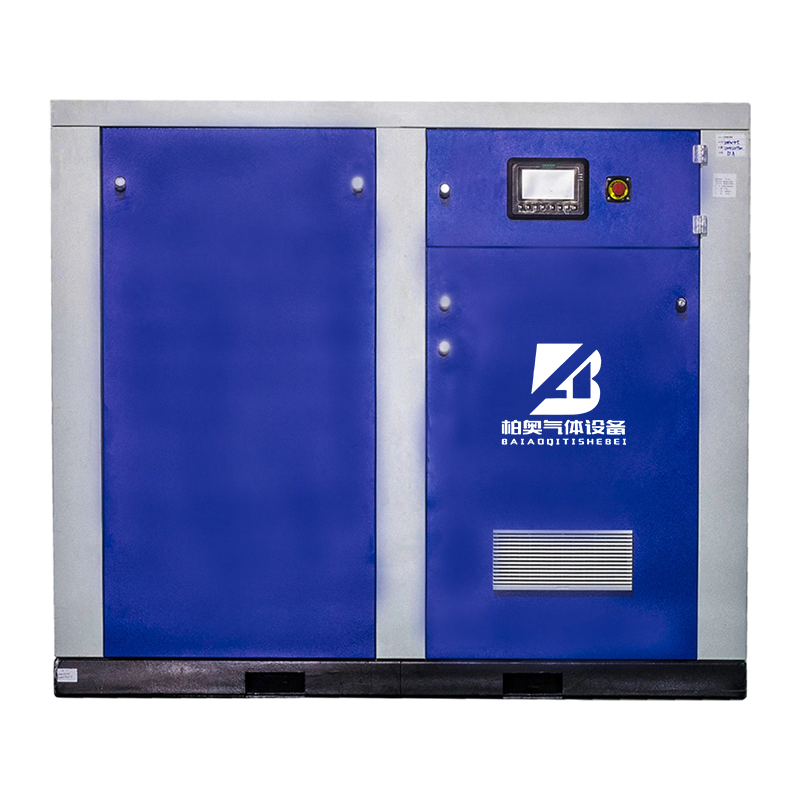
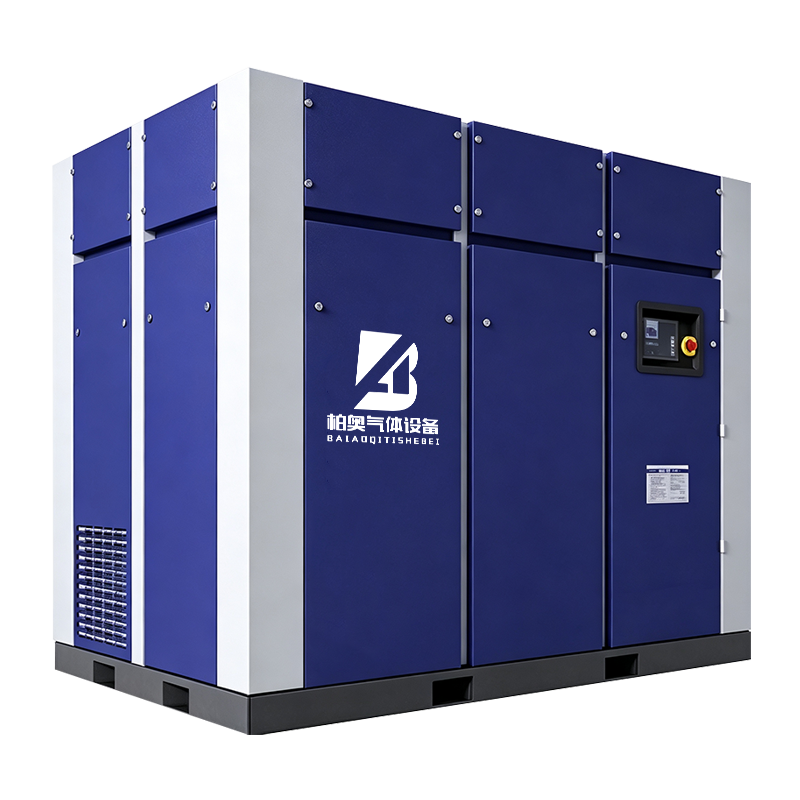 Dry Oil-Free Rotary Screw Air Compressor (PM VSD/FSD) Manufacturer, ExporterZhejiang Baiao Gas Equipment Co., Ltd is China wholesale Dry Oil-Free Rotary Screw Air Compressor (PM VSD/FSD) Manufacturer and Exporter....View Product →
| Factor | Oil-injected screw compressor | Oil-free (dry) screw compressor |
|---|---|---|
| Oil in the compression chamber | Yes; oil seals, lubricates and cools the rotors | No; rotors are synchronized by timing gears |
| Residual oil in delivered air | About 1-3 mg/m³ after the separator, reducible with filtration | Class 0 or Class 1 per ISO 8573-1 by design |
| First cost and maintenance | Lower first cost, simple oil and separator service | Higher first cost, more demanding service schedule |
| Typical applications | General manufacturing, automotive, mining, construction | Food and beverage, pharmaceuticals, electronics, coating |
Note that "oil-free" refers to the compression chamber, not to the entire package. An oil-free compressor still contains oil in its gearbox and bearings, and it still relies on separation barriers to keep that oil away from the air path. When absolute air purity matters, an oil-free machine is the defensible choice; when the process tolerates a small oil carryover, an oil-injected machine with correct filtration is often the economic winner.
Fixed Speed, Variable Speed, or Permanent Magnet
Most screw compressor lines are labeled with three drive configurations: FSD for fixed-speed drive, VSD for variable-speed drive, and PM for a permanent-magnet motor, almost always combined with a variable-speed drive. The choice determines how the machine behaves when demand changes.
A fixed-speed machine runs at constant speed and controls output by loading and unloading. It is the least expensive, the simplest to service, and a good match for a steady base load. A variable-speed drive adjusts the airend speed to the actual demand, which reduces energy use by roughly 20-35 percent on fluctuating loads. The reason is simple: an unloaded screw compressor still draws about 25 percent of full-load power while delivering nothing.
A permanent-magnet motor improves part-load efficiency and shortens the overall footprint, which is why PM/VSD machines are the usual upgrade path from fixed-speed units. In plants that run hard for most of the day, a two-stage oil-injected rotary screw air compressor is the next step: inter-stage cooling brings the air closer to isothermal compression, and a realistic 5-10 percent reduction in specific power over a single-stage unit adds up quickly across a 6,000-hour operating year.
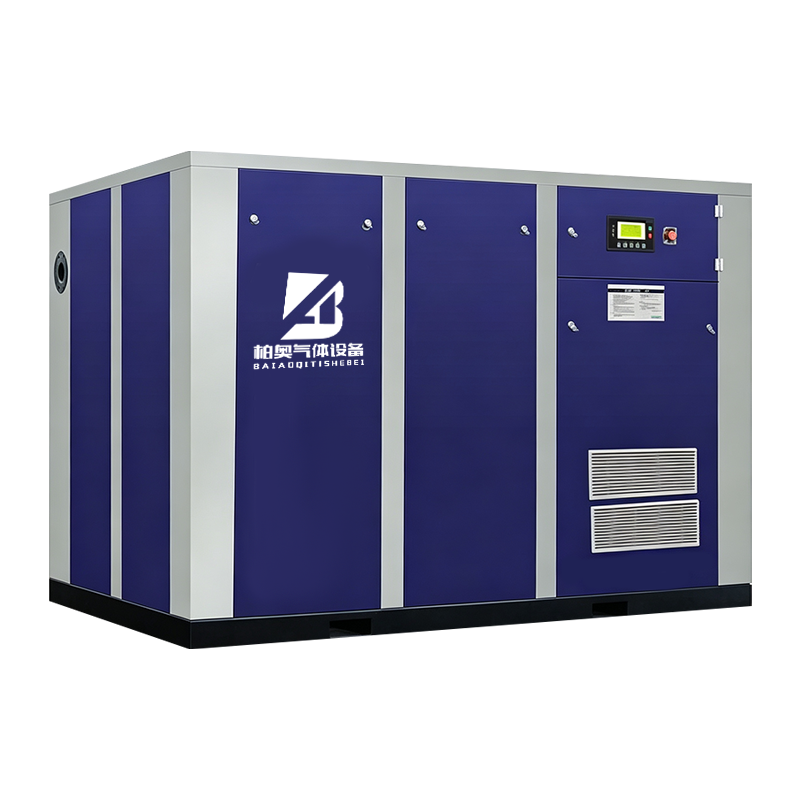
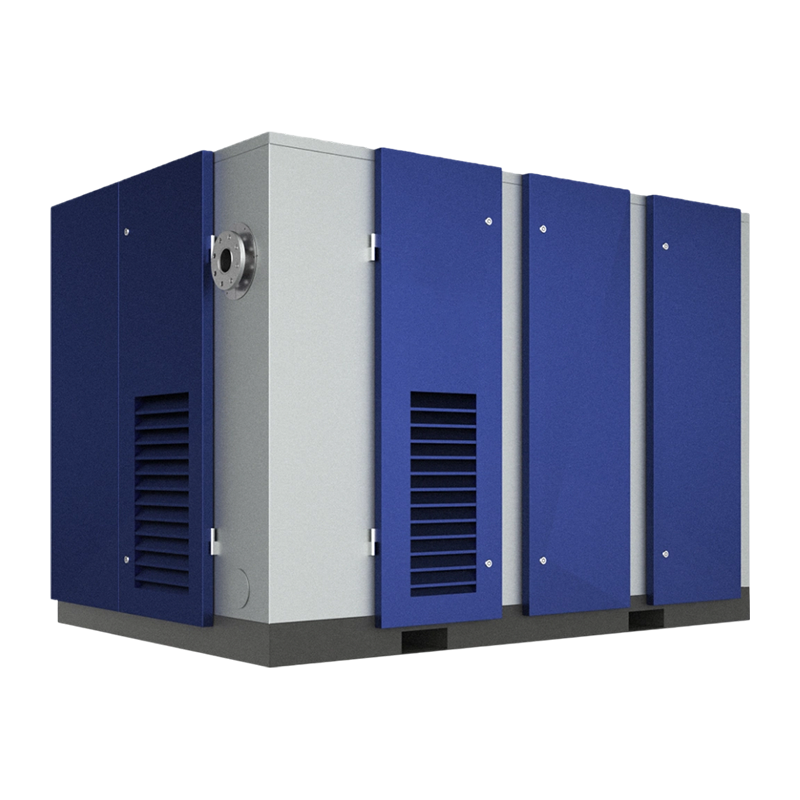 Two-Stage Compression Oil-Injected Rotary Screw Air Compressor (PM VSD/FSD) ManuZhejiang Baiao Gas Equipment Co., Ltd is China wholesale Two-Stage Compression Oil-Injected Rotary Screw Air Compressor (PM VSD/FSD) Manu...View Product →
Selection Checks That Prevent Expensive Mistakes
Most compressor disappointments are not caused by bad hardware; they are caused by bad specification. Work through these checks before comparing quotes.
Pressure and Free Air Delivery
Define the working pressure from the highest pressure the process genuinely needs, not from the old machine nameplate. Free air delivery (FAD) is quoted in m³/min at a reference inlet condition, and the flow falls as discharge pressure rises. Add about 10 percent margin to average demand. Do not oversize: an oversized machine spends too much time unloaded, and an oil-injected unit that idles for long periods can accumulate water in the oil sump.
Air Quality and Downstream Treatment
ISO 8573-1 defines acceptable levels of particles, water and oil in the delivered air. For instruments and general production, a refrigerated dryer with a 3-10 °C pressure dew point is usually sufficient; for outdoor piping or moisture-sensitive processes, a desiccant dryer reaching -40 °C or lower is the safer recommendation. Choose the filters only after you have fixed the purity class that the process requires.
Load Profile, Site Conditions and Total Cost of Ownership
Log the air demand across a full day. If it moves between 40 and 90 percent of rated flow, a VSD machine pays back its premium within two to three years. Remember that every kilowatt of shaft power ends up as heat, so compressor-room ventilation matters; intake air that is 3 °C warmer than design costs roughly 1 percent of volumetric efficiency. Above 1,000 meters above sea level, ask for the manufacturer's derating curve. And when comparing quotes, put energy first: electricity is typically 70-80 percent of the ten-year cost of a screw air compressor.
- Confirm the working pressure and FAD, and add about 10 percent margin.
- Define the ISO 8573-1 purity class before choosing dryers and filters.
- Check summer ambient temperature and ventilation at the planned site.
- Map the daily load profile; FSD for steady load, PM/VSD for variable load.
- Compare total cost of ownership over ten years, including maintenance.
Matching the Compressor to the Process
A screw compressor creates value only when its air quality matches the process. In food and beverage plants, where compressed air can touch packaging, dairy products or edible oils, even a small oil carryover can taint the product. Oil-free machines are therefore the default for direct contact, while oil-injected units are restricted to non-contact duties such as crate conveying or valve actuation. The food and beverage applications page describes practical layouts for both cases.
Electronics plants set the bar even higher. SMT soldering, PCB washing and pneumatic actuation on pick-and-place lines normally require a pressure dew point near -40 °C and particle and oil filtration to ISO 8573-1 Class 1. Dry, clean air prevents condensation on circuit boards and keeps small nozzles from clogging. The electronics manufacturing applications page is a good starting point for a specification. In petrochemical facilities, the common pattern is an oil-injected machine for general plant air, with high-efficiency coalescing filters and a desiccant dryer protecting instrument air circuits.
A Final Word on Specification Discipline
The wrong compressor is rarely the machine's fault; it is the result of an undefined operating point. Define the pressure, the flow, the purity class and the load profile before opening any brochure. The decision then narrows to three pairs: oil-free versus oil-injected, fixed speed versus variable speed, and single stage versus two stage. A manufacturer that builds the compressor and the downstream purification equipment together, as Baiao does with its screw compressors, dryers, filters and gas treatment systems, removes much of the integration risk and gives you a single point of accountability from the air inlet to the process line. Get those decisions right, and the machine you install will still be the right one ten years from now.
- Tel: +86-15057127179
+86-13588382771 - Email: huang.yifan0215@gmail.com
- Address: Huanshan Township, Fuyang District, Hangzhou City, Zhejiang Province
Copyright © Zhejiang Baiao Gas Equipment Co., Ltd. All Rights Reserved.
Privacy
Gas Generator Plant Manufacturer, Industrial Purification Equipment Plant
