 en
en русский
 Español
 عربى
عربى
Oxygen Generator Selection: PSA vs VPSA Purity Ratings and Real Operating Costs
An automotive parts plant in the Yangtze Delta is paying about $0.45 per Nm³ for delivered liquid oxygen. At an average consumption of 80 Nm³/h, that is a $315,000 annual supply budget. An on-site PSA oxygen generator can cut that cost by more than half, but only if the equipment is selected against the true flow profile, purity target, and electricity price of the site.
Content
- 1 On-Site Oxygen Generation: The Financial Break-Even Point
- 2 PSA Oxygen Generators: The 93% Workhorse for 3-200 Nm³/h
- 3 VPSA Oxygen Generators: The Choice for Large Continuous Flows
- 4 Oxygen Purity: The Specification That Changes Everything
- 5 Energy Consumption: The Single Biggest Cost Driver
- 6 Supplier Evaluation: The Three Failure Points to Check
- 7 FAQ: Industrial Oxygen Generator Selection
On-Site Oxygen Generation: The Financial Break-Even Point
On-site oxygen generation becomes cheaper than delivered liquid oxygen once steady demand exceeds roughly 10 Nm³/h and the plant plans to run the system for more than two shifts per day. Below that threshold, the capital cost and maintenance requirements are hard to justify against a simple tank delivery contract.
The reason is the cost structure of liquid oxygen. Total delivered cost includes the energy required to liquefy oxygen (about 0.4-0.6 kWh per kilogram), cryogenic tank rental, road transport, and boil-off losses during storage. These logistics add 30-50% to the base gas price in most regions. An on-site generator replaces all of that with electricity and ambient air, which are already available at the factory gate.
The compressed air side matters as much as the oxygen unit. A reliable oxygen generator needs clean, dry air at the correct pressure and volume. If the existing compressed air system is already at 90% capacity, the oxygen generator requires either a dedicated air compressor or a non-negotiable upgrade to the current plant air network.
PSA Oxygen Generators: The 93% Workhorse for 3-200 Nm³/h
Pressure swing adsorption (PSA) is the default oxygen generator technology for flows up to about 200 Nm³/h at 90-95% purity, delivering the lowest capital cost per Nm³ in that range.
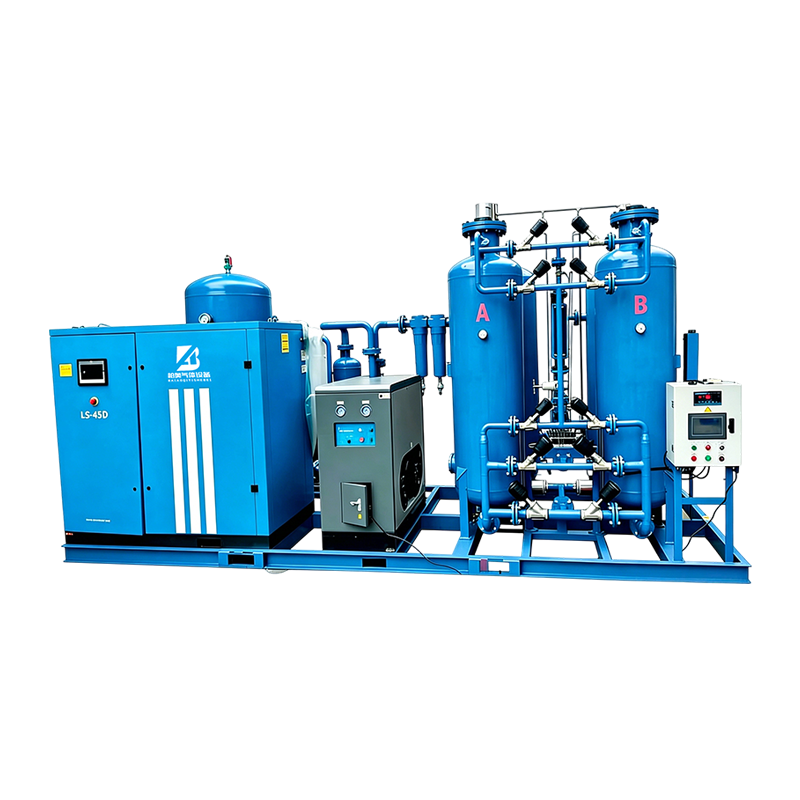
A PSA oxygen generator compresses ambient air, removes moisture, oil, and particles, then pushes the air through a vessel filled with zeolite molecular sieve. The sieve adsorbs nitrogen under pressure while oxygen passes through. When the bed reaches saturation, the pressure drops and the nitrogen is released. Two beds alternate between the adsorption and regeneration phases to produce a continuous oxygen stream.
The BAO pressure swing adsorption oxygen generator from Zhejiang Baiao Gas Equipment Co., Ltd. is built around this principle, producing oxygen at 93% +/- 3% purity, the grade used in laser cutting, food packaging, wastewater aeration, aquarium life support, and glass melting.
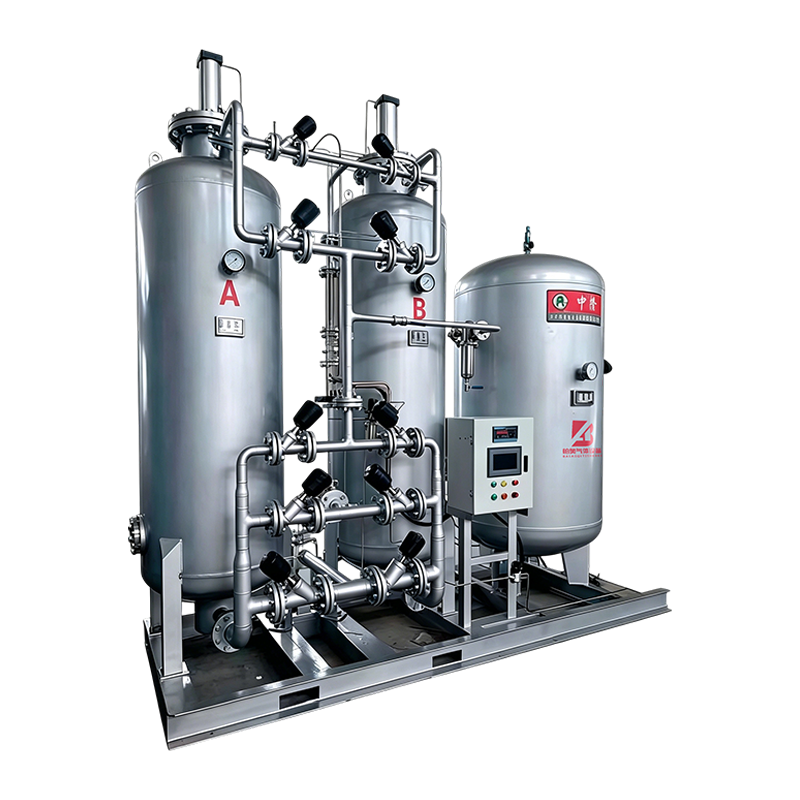 BAO Pressure Swing Adsorption Oxygen Generator for Industrial UseThis PSA unit produces oxygen at 93% purity suitable for laser cutting, food packaging, and wastewater aeration. It operates at 0.1-0.5 MPa, using zeolite molecular sieves to separate nitrogen efficiently.View Product →
PSA systems deliver oxygen at 4-10 bar without a downstream booster. If the process needs 150 bar for cylinder filling, an oxygen booster compressor can raise the pressure without changing the adsorption chemistry.
- Capital cost per Nm³ is the lowest in the 3-200 Nm³/h range
- Delivery pressure up to 10 bar directly from the generator
- Specific energy consumption between 0.35 and 0.55 kWh/Nm³
- Standard purity of 93% +/- 3% covers most industrial applications
VPSA Oxygen Generators: The Choice for Large Continuous Flows
Vacuum pressure swing adsorption (VPSA) becomes the right technology when oxygen demand exceeds roughly 300-500 Nm³/h and the process can accept oxygen at 90% purity.
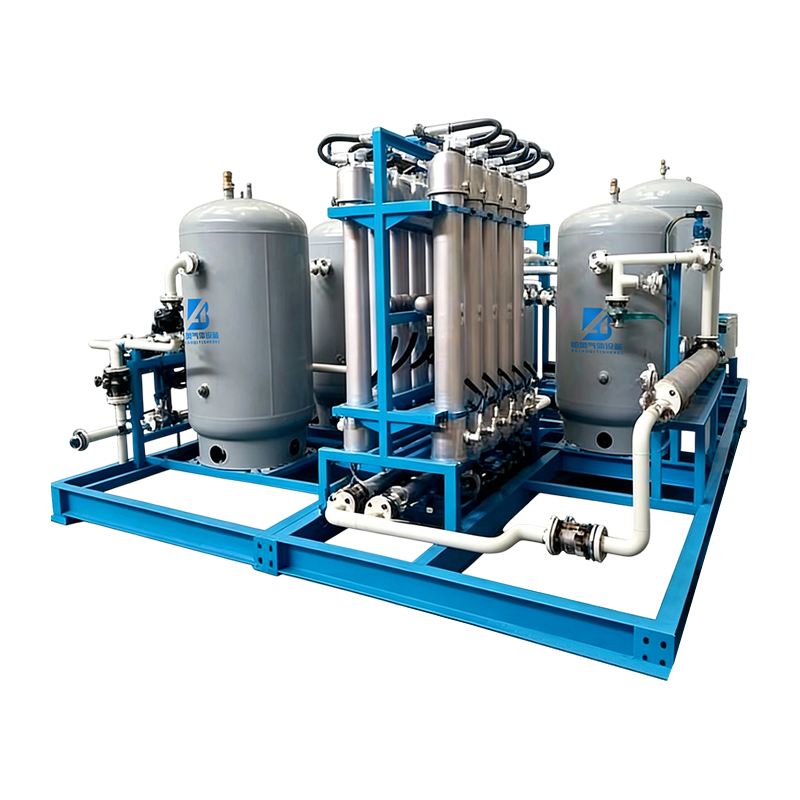
VPSA uses the same zeolite adsorption principle but adds a vacuum pump to pull nitrogen out of the bed during regeneration. The pressure differential across the cycle shrinks, which usually cuts the specific energy consumption to 0.25-0.40 kWh/Nm³ at atmospheric delivery pressure.
Baiao's VPSA vacuum pressure swing adsorption oxygen generator covers the 200-3000+ Nm³/h range, making it a fit for steel plants, power station flue gas treatment, municipal wastewater aeration, and non-ferrous metallurgy. The trade-off is low delivery pressure: VPSA oxygen leaves the unit at 1.5-3 bar, so any process running at 7-10 bar needs a dedicated oxygen booster compressor.
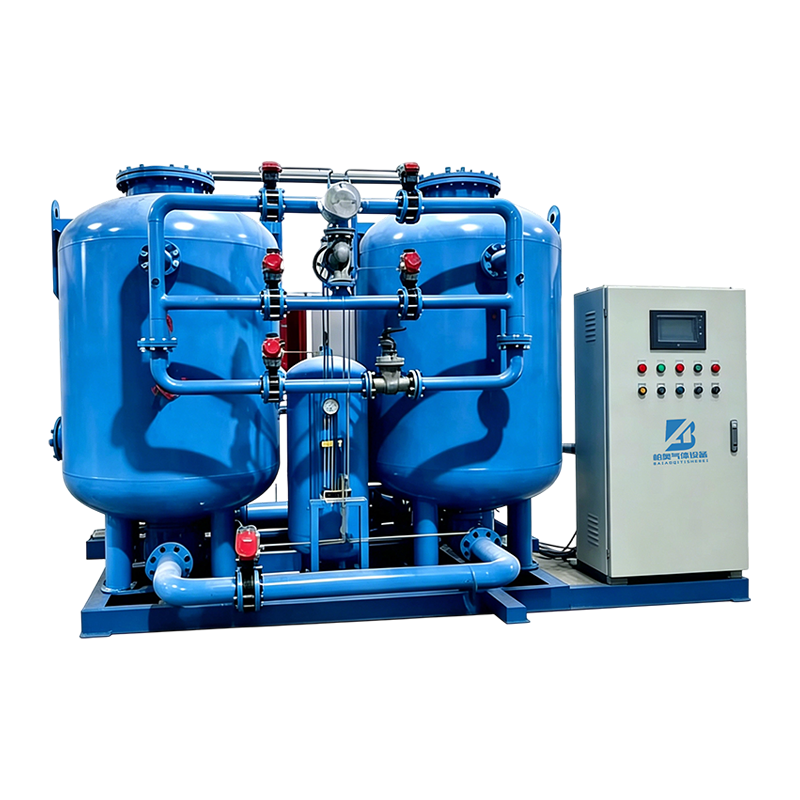 VPSA Vacuum Pressure Swing Adsorption Oxygen GeneratorDesigned for large-scale oxygen demands above 200 Nm³/h, this VPSA unit delivers oxygen at low pressure (1.5-3 bar) and is ideal for steel plants and wastewater treatment, with energy savings in continuous operation.View Product →
For sites with a continuous 24/7 oxygen demand above 500 Nm³/h, the energy saving of a VPSA unit versus a PSA unit pays for the vacuum pump and the larger footprint within the first two years.
Oxygen Purity: The Specification That Changes Everything
The purity level your process actually needs determines both the technology selection and the energy bill. Moving from 93% to 99.5% can nearly double the power consumption per Nm³.
| Application | Purity | Preferred technology |
| Laser cutting | 93-99.5% | PSA + oxygen booster |
| Wastewater aeration | 90-93% | VPSA for large flows |
| Glass melting | 93%+ | PSA or VPSA |
| Aquaculture | 90-93% | PSA |
| Medical / hospital | 93% | PSA + booster |
The 93% figure exists for a reason. At that purity, the zeolite sieve operates efficiently and the oxygen cost stays low. Pushing to 99.5% requires a catalytic purification step or a nitrogen rejection unit, which adds capital cost and operating expense. If the process can tolerate 90-93% oxygen, specifying 93% purity is the financially rational decision.
Energy Consumption: The Single Biggest Cost Driver
Electricity is 70-80% of the total operating cost of an oxygen generator, so specific energy consumption in kWh/Nm³ is the first number to compare across supplier quotations.
A 100 Nm³/h PSA unit at 0.40 kWh/Nm³ and $0.10/kWh uses 40 kWh per hour, costing $4.00/h. The same oxygen flow from delivered liquid at $0.45/Nm³ costs $45/h. That $41/h difference extends to $359,000 per year at 24/7 operation, before capital recovery.
Supplier Evaluation: The Three Failure Points to Check
The three failure modes that kill oxygen generator projects are undersized air compressors, inadequate after-treatment, and a manufacturer that cannot support the equipment through its service life. Each one is preventable with a structured evaluation.
- Confirm the flow profile: the supplier should quote against average and maximum Nm³/h demand, not just installed capacity.
- Request a complete scope: air compressor, filters, dryer, oxygen generator, booster, safety piping, and a nitrogen purge for shutdown.
- Ask about the molecular sieve: its type, replacement cycle, and whether the guarantee covers performance over multiple years.
- Check after-sales response: the nearest service point, spare parts stock, and the response time commitment.
- Visit an installed site or call a reference before placing the order.
Zhejiang Baiao Gas Equipment Co., Ltd. builds both PSA and VPSA oxygen generators as part of a complete gas equipment product line that also includes industrial air compressors and gas purification equipment. The company supports a range of industrial applications from petrochemical to food processing.
FAQ: Industrial Oxygen Generator Selection
What is the difference between a PSA and a VPSA oxygen generator?
PSA swings the adsorption bed between high pressure and atmospheric pressure to regenerate the zeolite. VPSA uses a vacuum pump for the same task, narrowing the cycle pressure range and cutting specific energy consumption. PSA suits flows up to about 200 Nm³/h, while VPSA handles 200 to several thousand Nm³/h.
Can a PSA oxygen generator produce medical-grade oxygen?
Yes, a PSA unit producing 93% +/- 3% oxygen meets the USP medical oxygen specification. The air intake and delivery piping must also be qualified for medical service, and the installation needs the relevant local authority approval.
How much does an oxygen generator cost to operate?
Electricity is the largest cost. At $0.10/kWh and 0.40 kWh/Nm³, the electricity cost is about $0.04 per Nm³. Adding maintenance, zeolite replacement, and capital recovery brings the total to $0.12-0.22 per Nm³.
How long does an oxygen generator last?
A well-maintained PSA or VPSA unit lasts 10-15 years. The zeolite molecular sieve is typically replaced after 8-10 years, and the compressor follows its own maintenance schedule.
- Tel: +86-15057127179
+86-13588382771 - Email: huang.yifan0215@gmail.com
- Address: Huanshan Township, Fuyang District, Hangzhou City, Zhejiang Province
Copyright © Zhejiang Baiao Gas Equipment Co., Ltd. All Rights Reserved.
Privacy
Gas Generator Plant Manufacturer, Industrial Purification Equipment Plant
