 en
en русский
 Español
 عربى
عربى
Micro-Heat Regenerative Adsorption Dryers for Efficient Industrial Compressed-Air Treatment
Reliable compressed air is essential in modern manufacturing. Pneumatic controls, instrumentation, gas separation systems, packaging equipment, heat-treatment lines, electronics production, and many other industrial processes require air with a stable pressure and low moisture content. When compressed air contains excessive water vapor, the results can include corrosion, frozen control lines, damaged valves, contaminated products, unstable pneumatic performance, and shortened equipment life. A suitable adsorption dryer therefore plays an important role in the safety, efficiency, and continuity of industrial operations.
The BEL Micro-heat Regenerative Adsorption Dryer is designed for industrial users that need dependable drying performance while reducing the regeneration-air consumption associated with conventional heatless adsorption dryers. It combines heated regeneration with the operating principles of a regenerative twin-tower adsorption system. This approach allows the desiccant to be regenerated using heated gas, improving the regeneration effect and limiting the amount of compressed gas used during the regeneration stage.
Manufactured by Zhejiang Baiao Gas Equipment Co., Ltd., the dryer is part of a broader portfolio of gas separation and purification equipment. The company integrates research and development, engineering design, production, installation, and after-sales service. Its product range includes PSA nitrogen generators, PSA oxygen generators, membrane nitrogen and oxygen generators, nitrogen purification units, ammonia decomposition hydrogen purification systems, and industrial gas-treatment equipment.
The dryer is suitable for users who require a pressure dew point of up to -40°C as a standard configuration, with optional dew points from -40°C to -73°C. Its rated operating pressure is 0.4–1.0 MPa, while versions for pressure ranges from 1.0–3.0 MPa are available. A range of capacities, connection sizes, power ratings, and physical dimensions enables the equipment to serve both compact installations and larger industrial air-treatment systems.
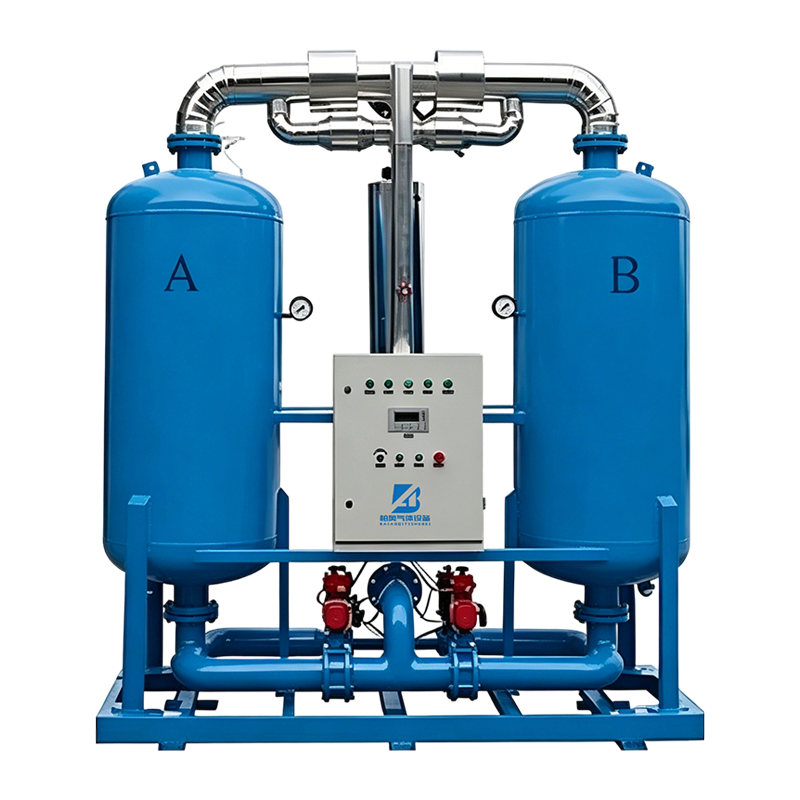
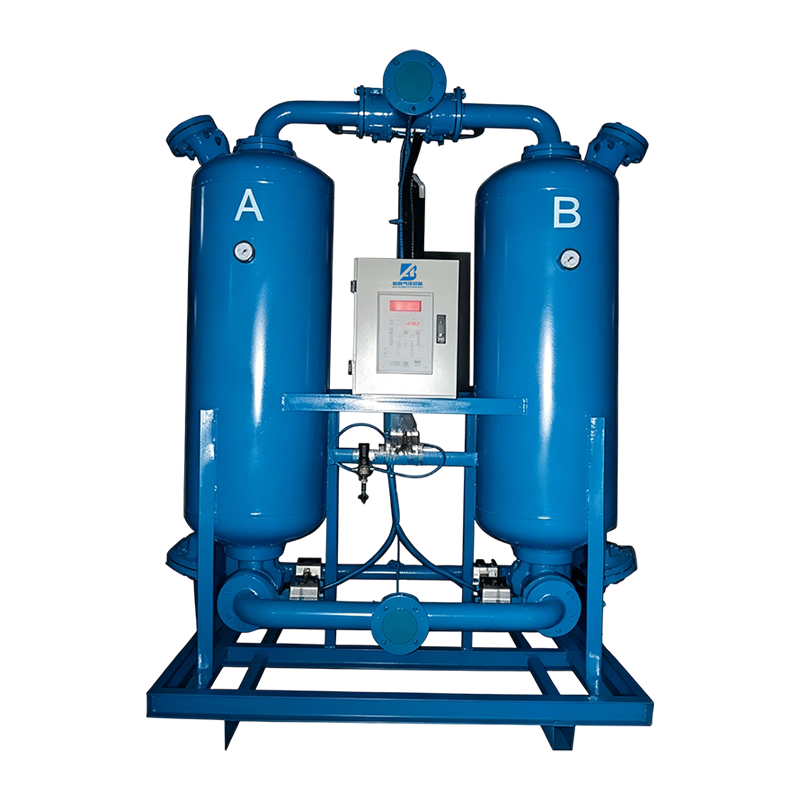
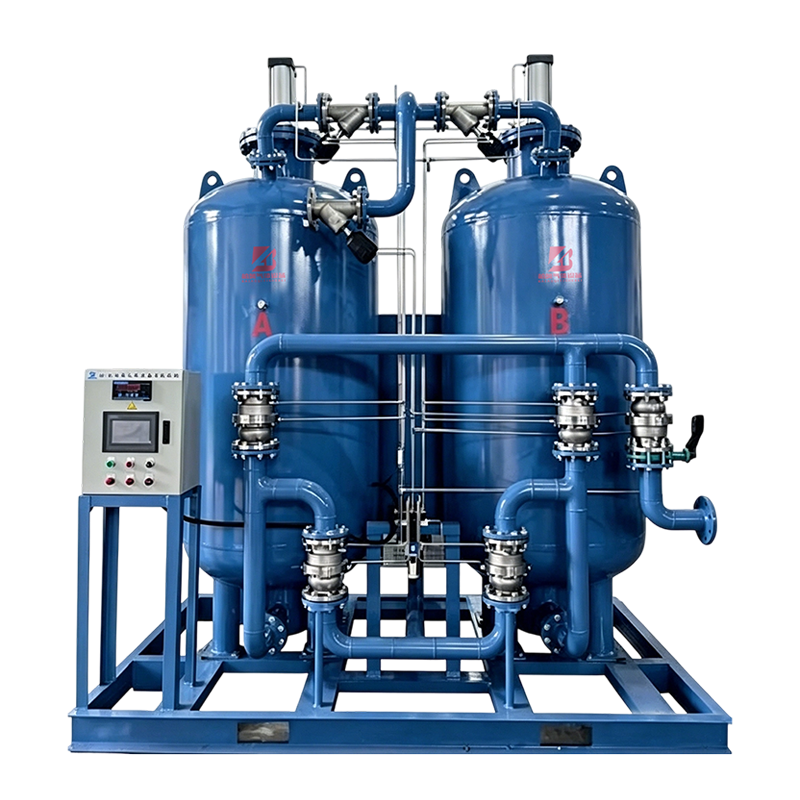
BEL Micro-heat Regenerative Adsorption Dryer
Content
- 1 Understanding the Role of an Adsorption Dryer
- 2 Working Principle of the Micro-Heat System
- 3 Core Technical Specifications
- 4 Advantages Compared with Conventional Dryer Designs
- 5 Manufacturing and Engineering Strengths
- 6 Model Range and Capacity Selection
- 7 Installation Requirements
- 8 Operation and Maintenance
- 9 Applications Across Industrial Sectors
- 10 Energy and Lifecycle Considerations
- 11 Why Manufacturer Integration Matters
- 12 Project Selection Checklist
- 13 Q&A
- 13.1 What is a micro-heat regenerative adsorption dryer?
- 13.2 What pressure dew point can the dryer provide?
- 13.3 How much regeneration air does the dryer consume?
- 13.4 What is the maximum inlet temperature?
- 13.5 What is the normal operating pressure range?
- 13.6 How does the PLC improve operation?
- 13.7 How long are the pneumatic valves expected to last?
- 13.8 Why is airflow diffusion important?
- 13.9 How should the dryer be protected from contamination?
- 13.10 How should the correct model be selected?
- 13.11 Can the dryer be used with gas-generation equipment?
- 13.12 Does the published model table contain all electrical information?
- 13.13 What maintenance is required?
- 13.14 Is the dryer suitable for every compressed-air application?
- 14 Conclusion
- 15 References
- 16 Product: BEL Micro-heat Regenerative Adsorption Dryer
Understanding the Role of an Adsorption Dryer
Compressed air naturally contains atmospheric moisture. During compression, the concentration of water vapor increases, and cooling after compression causes some of the moisture to condense. However, condensed water is only part of the problem. Water vapor that remains in the compressed-air stream can travel downstream and enter pneumatic equipment, process lines, storage tanks, and sensitive production areas.
An adsorption dryer removes water vapor by passing compressed air through a desiccant material. The desiccant has a porous structure and a large internal surface area. Moisture molecules adhere to the desiccant surface as the air flows through the adsorption vessel. Once the desiccant becomes saturated, it must be regenerated so that it can continue removing moisture.
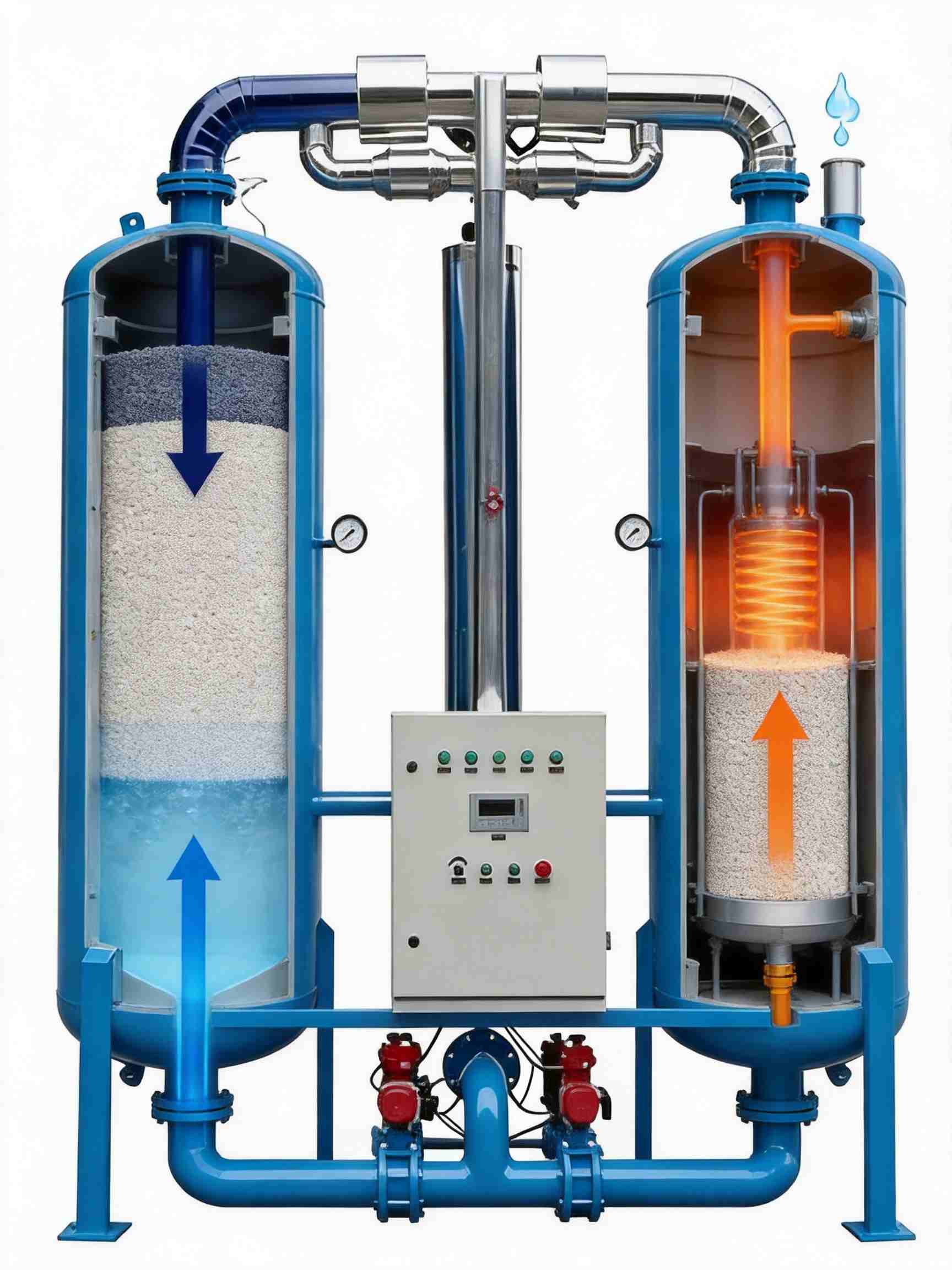
A regenerative adsorption dryer normally uses two adsorption vessels. One vessel operates in the adsorption phase while the other is regenerated. After a defined period, the vessels switch functions. This alternating arrangement permits continuous dry-air delivery without interrupting the main process-air supply.
In a heatless dryer, a portion of the dry compressed air is expanded and used to remove moisture from the offline desiccant bed. This method is simple and has a relatively straightforward control arrangement, but it can consume a considerable quantity of product air during regeneration. A heated regenerative dryer adds thermal energy to the regeneration process. The additional heat helps desorb moisture from the desiccant, allowing the regeneration flow to be reduced.
The micro-heat design combines the advantages of both approaches. Regeneration gas is heated before it passes through the desiccant bed. The heating process improves moisture removal, while the controlled regeneration flow helps reduce compressed-air losses. This is particularly valuable in facilities where compressor capacity is limited or where energy consumption is a major operating concern.
Working Principle of the Micro-Heat System
Adsorption Phase
Wet compressed air enters the operating adsorption vessel after upstream treatment. The airflow passes through the desiccant bed, where water vapor is captured by adsorption. The treated air then exits the vessel and flows to the plant distribution system or downstream process equipment.
The internal airflow arrangement is important. If air distribution is uneven, certain areas of the desiccant bed may receive a disproportionately high flow. These areas can become saturated earlier than the rest of the bed, leading to premature moisture breakthrough. The dryer uses a specialized airflow diffusion device to promote more uniform gas distribution and to help maximize the useful service life of the desiccant.
Regeneration Phase
While one vessel dries the compressed air, the second vessel is isolated from the main wet-air stream. A controlled quantity of regeneration gas is directed through the offline vessel. Before entering the desiccant bed, this gas is heated. The heated gas increases the ability of the regeneration stream to carry away moisture that has accumulated on the desiccant.
Compared with an unheated regeneration process, the thermal energy improves the regeneration effect. The desiccant can be restored more effectively, helping the dryer maintain its specified dew-point performance over repeated operating cycles. The stated regeneration-air consumption is approximately 4–6 percent, depending on the operating conditions and selected configuration.
Cooling and Pressure Equalization
After the heating stage, the regenerated bed may require cooling before it returns to adsorption service. The exact sequence is controlled by the programmable logic controller and the valve arrangement. Proper switching, pressure management, and timing prevent sudden pressure disturbances and help protect the desiccant from mechanical stress.
Once the regeneration sequence is complete, the two vessels change roles. The previously regenerated vessel receives wet compressed air, while the previously loaded vessel begins regeneration. The cycle continues automatically according to the selected cycle time, which is specified as 60–120 minutes.
The use of two alternating vessels provides continuous operation. The control system coordinates inlet valves, outlet valves, regeneration valves, heating functions, pressure equalization steps, and alarm conditions. Stable sequencing is essential because even a well-designed desiccant bed cannot deliver reliable dry air if the valves switch incorrectly or the cycle timing is inconsistent.
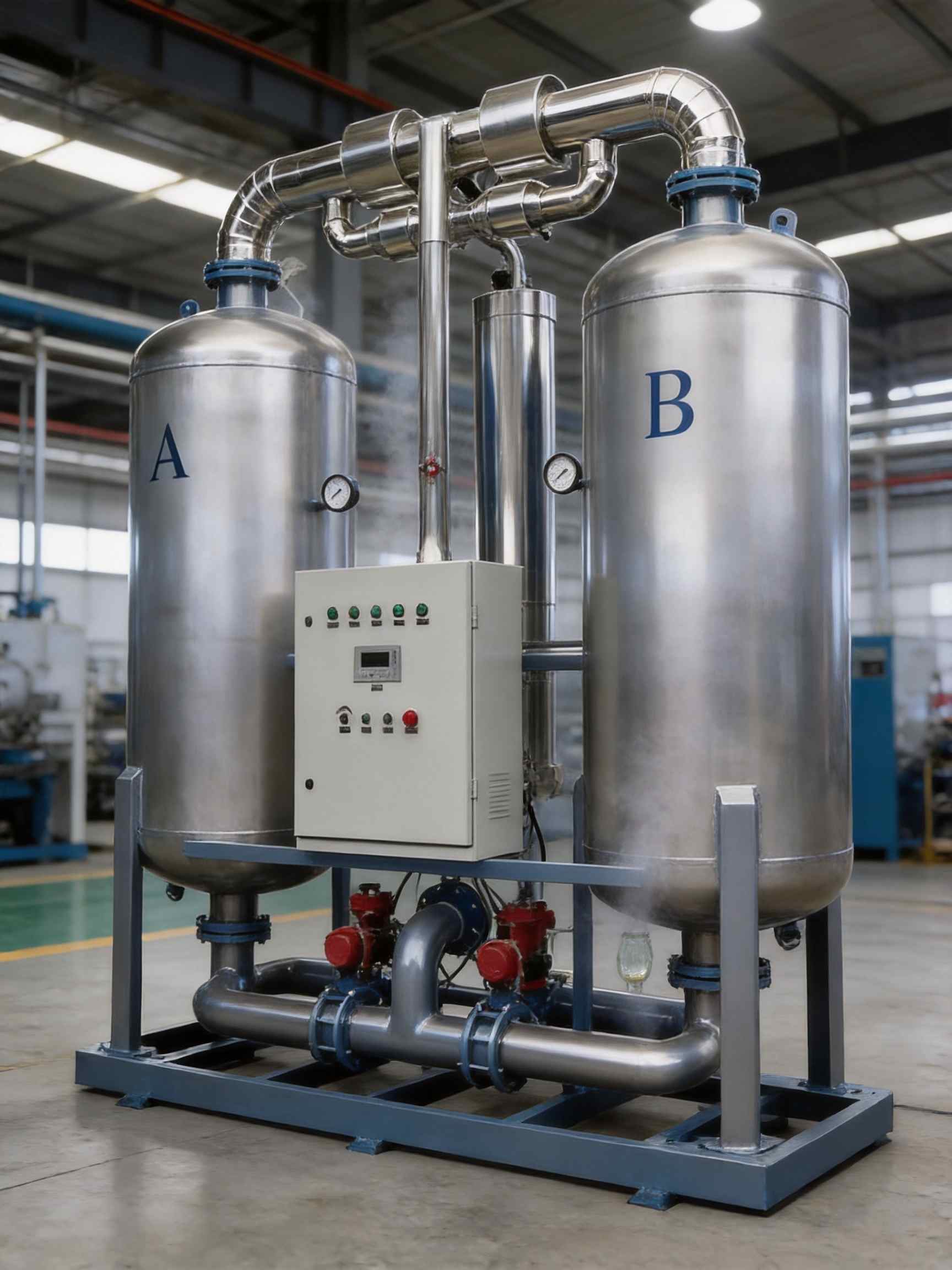
Core Technical Specifications
The standard operating pressure range is 0.4–1.0 MPa. Configurations for 1.0–3.0 MPa are available for applications that operate at higher pressure. Pressure selection affects the vessel design, valve specifications, gas flow, heat-transfer conditions, and overall system configuration. The correct pressure rating should be selected according to the actual compressor discharge pressure and the requirements of the downstream process.
The standard dew point is no higher than -40°C. Depending on the application, configurations from -40°C to -73°C are available. A lower pressure dew point may be required for outdoor pipelines, cold environments, sensitive instrumentation, pharmaceutical processes, electronics production, or applications where even small quantities of moisture can cause product or equipment problems.
The inlet temperature should not exceed 50°C. Inlet temperature is a significant design factor because hot air carries more water vapor and can affect the adsorption capacity of the desiccant. Appropriate aftercooling, moisture separation, and upstream filtration are therefore important parts of a complete compressed-air treatment system.
Regeneration-air consumption is specified at no more than approximately 4–6 percent. Actual consumption can vary with inlet pressure, inlet temperature, flow rate, required dew point, cycle settings, ambient conditions, and the condition of the desiccant. Nevertheless, the micro-heat configuration is intended to reduce the air loss commonly associated with conventional heatless regeneration.
The pressure drop is specified at no more than 0.02 MPa. Low pressure drop helps preserve useful compressed-air pressure for downstream equipment. It can also reduce the need to increase compressor discharge pressure to compensate for losses across the treatment system. Because compressor energy consumption tends to rise when discharge pressure is increased, pressure-drop control is an important part of lifecycle efficiency.
The cycle time can be set within a range of 60–120 minutes. The appropriate cycle depends on the model, operating conditions, desired dew point, desiccant condition, and control strategy. A longer or shorter cycle may be selected by qualified technical personnel when required by the application.
| Technical parameter | Standard specification | Available or applicable range |
|---|---|---|
| Operating pressure | 0.4–1.0 MPa | 1.0–3.0 MPa available |
| Pressure dew point | ≤ -40°C | -40°C to -73°C available |
| Inlet temperature | ≤ 50°C | Must be controlled by the system design |
| Regeneration-air consumption | ≤ 4–6% | Depends on operating conditions |
| Pressure drop | ≤ 0.02 MPa | Subject to flow and installation conditions |
| Cycle time | 60–120 minutes | Selected according to application requirements |
Advantages Compared with Conventional Dryer Designs
Reduced Regeneration-Air Loss
One of the most important advantages of the micro-heat design is its reduced regeneration-air requirement. A conventional heatless dryer must use a portion of already compressed dry air to regenerate the offline bed. That air is normally vented after carrying moisture away from the desiccant, so it does not reach the production line.
By adding controlled heat, the regeneration process can remove moisture more effectively with a smaller quantity of gas. The stated consumption of approximately 4–6 percent is intended to reduce the amount of product air diverted from the main process. This can improve the effective output of the compressor system and reduce the cost associated with producing air that is later used for regeneration.
The energy benefit depends on local electricity prices, compressor efficiency, operating hours, and the actual flow requirement. Even when the dryer includes an electrical heating element, a reduction in regeneration-air consumption may provide a practical operating advantage. A complete evaluation should compare both electrical heating demand and compressor energy savings rather than considering only the installed heater power.
Improved Regeneration Effect
Heating the regeneration gas increases its ability to desorb water from the desiccant. More effective regeneration helps reduce residual moisture within the bed. This supports stable dew-point performance and can help the desiccant operate effectively over repeated adsorption and regeneration cycles.
Stable regeneration is especially important in applications with continuous operation. If regeneration is incomplete, the desiccant may gradually retain more moisture from one cycle to the next. Over time, this can cause earlier moisture breakthrough, inconsistent dew point, and greater stress on downstream equipment. The micro-heat method is designed to address this operating challenge through a combination of heat and controlled gas flow.
Lower Pressure Loss
A specified pressure drop of no more than 0.02 MPa helps maintain downstream pressure. Low resistance through the vessel, desiccant bed, valves, and internal diffusion components contributes to improved system efficiency. It also makes it easier for the dryer to integrate into existing compressed-air systems without requiring a substantial increase in compressor discharge pressure.
Automatic and Stable Operation
The dryer uses an imported PLC intelligent control system. Programmable control allows the equipment to manage the alternating vessel sequence and coordinate the regeneration process. Automated operation reduces the need for continuous manual intervention and provides a repeatable operating sequence.
PLC control can also support easier monitoring of operating status, cycle progression, valve actions, heating stages, and fault conditions. The final control functions depend on the supplied configuration, but the basic purpose is to improve stability, reliability, and operational convenience.
Long-Service Pneumatic Valves
The equipment uses advanced pneumatic valves with a stated service life of more than one million cycles. Valve durability is a major consideration in regenerative dryers because the switching sequence may be repeated continuously over many years. A valve failure can cause pressure imbalance, incorrect regeneration, wet-air breakthrough, or unplanned downtime.
A long-life valve design can reduce maintenance frequency and improve the availability of the complete dryer. It is also important to operate the valves within their specified pressure, temperature, and cleanliness limits. Upstream filtration and appropriate condensate management remain necessary for protecting pneumatic components from oil, liquid water, and solid contamination.
Convenient Desiccant Replacement
The flanged filling port is designed to make desiccant replacement more convenient. During service, the filling and removal of desiccant can be time-consuming if vessel access is difficult. A practical port design can help maintenance personnel perform replacement more efficiently while reducing the amount of disassembly required.
Desiccant should be replaced according to actual performance, operating history, manufacturer guidance, and inspection results. A planned replacement procedure should include depressurization, isolation, safe removal, inspection of internal components, correct filling, and verification that the desiccant bed is evenly distributed.
Clear Operating Visibility
The unique sight-glass design provides a visible indication of operating conditions. Visual access can help operators understand the condition of the equipment during inspection and maintenance. It may also assist in identifying abnormal behavior, such as unexpected movement, contamination, or other conditions that require technical attention.
Visibility is particularly useful when combined with PLC monitoring. Electronic control provides operating information, while the sight glass offers a direct visual reference. These two methods can complement each other during routine inspections and troubleshooting.
Protection of Desiccant Service Life
The specialized airflow diffusion device helps distribute gas more evenly through the desiccant bed. Uniform distribution reduces the risk of channeling, localized high velocity, and uneven saturation. It also helps the desiccant perform more consistently across the vessel cross-section.
Desiccant life is affected by many factors, including liquid water carryover, oil contamination, excessive inlet temperature, rapid pressure changes, mechanical abrasion, and incorrect airflow. The diffusion arrangement addresses one important part of this challenge by improving airflow management inside the adsorption vessel.
Manufacturing and Engineering Strengths
Zhejiang Baiao Gas Equipment Co., Ltd. operates a standardized workshop of approximately 3,000 square meters, an office area of approximately 500 square meters, and a warehouse of approximately 500 square meters. These facilities support the company’s activities in product development, equipment manufacturing, material handling, assembly, testing, and customer service.
The company integrates research and development, design, production, installation, and after-sales service. This integrated structure is valuable for gas-treatment equipment because successful operation depends on more than the vessel itself. System performance also depends on process calculations, piping arrangement, controls, filtration, installation quality, commissioning, and maintenance support.
Design and engineering activities begin with the customer’s operating requirements. Important factors include compressed-air flow, pressure, inlet temperature, target dew point, ambient conditions, duty cycle, available electrical power, installation space, connection size, and the type of downstream equipment being protected. Matching the dryer to these conditions helps prevent both under-sizing and unnecessary over-sizing.
The company’s product development work is based on overseas technologies that have been adapted and optimized for industrial conditions in China. This approach combines established gas-treatment principles with practical engineering adjustments for local operating environments, manufacturing requirements, service conditions, and customer expectations.
Production quality depends on consistent fabrication and assembly. Pressure vessels and piping must be produced in accordance with the applicable design and manufacturing requirements. Internal components must be positioned correctly so that gas distribution, desiccant retention, and pressure management function as intended. Valves, heaters, instruments, electrical components, seals, and control cabinets must be assembled with attention to compatibility and serviceability.
Before delivery, equipment should be checked for assembly quality, leakage, control response, valve switching, heater operation, instrument signals, and general appearance. Commissioning procedures should confirm that the dryer reaches the required operating conditions under the customer’s actual compressed-air load. A professional manufacturing process connects design calculations with production inspection and field verification.
The company’s experience in gas separation and purification equipment also supports the development of integrated systems. A facility may require not only compressed-air drying but also nitrogen generation, oxygen generation, membrane separation, gas purification, or hydrogen purification. A manufacturer with experience across these areas can better understand the interaction between dryers, filters, compressors, generators, storage tanks, and process distribution networks.
After-sales service is another important manufacturing strength. Installation guidance, commissioning support, operating instructions, spare-parts planning, troubleshooting, and maintenance recommendations all contribute to long-term system value. A technically sound dryer can still underperform if it is incorrectly installed or operated outside its design conditions. Integrated support helps customers obtain the intended results from the equipment.
Model Range and Capacity Selection
The BEL series includes models with rated gas-processing capacities from approximately 3 Nm³/h to 220 Nm³/h. Connection sizes range from DN32 to DN250 in the listed configurations. This range allows users to select equipment according to actual process demand rather than using a single standard size for every installation.
Model selection should be based on the maximum required flow, normal operating flow, inlet pressure, pressure dew point, inlet temperature, and future expansion plans. Selecting a dryer only according to the average flow may cause insufficient performance during peak production. Selecting an excessively large unit may increase capital cost, physical footprint, and energy consumption without providing a corresponding benefit.
Where the compressed-air demand changes significantly during the day, the customer should discuss the load profile with the equipment supplier. Intermittent demand, seasonal production, multiple shifts, and future capacity increases can influence the recommended model and control settings.
| Model | Rated gas-processing capacity (Nm³/h) | Inlet and outlet diameter DN (mm) | Power supply (V/Hz) | Installed power (kW) | Dimensions L × W × H (mm) | Weight (kg) |
|---|---|---|---|---|---|---|
| BEL-3 | 3 | 32 | 220/50 | 1.35 | 1150 × 385 × 1370 | 370 |
| BEL-6 | 7.2 | 40 | Not stated in the supplied data | 3.1 | 1310 × 500 × 1830 | 675 |
| BAL-12 | 13.2 | 50 | 380/50 | 5.8 | 1550 × 625 × 1930 | 1050 |
| BEL-20 | 22 | 65 | Not stated in the supplied data | 9.7 | 1950 × 685 × 2180 | 1050 |
| BEL-30 | 33 | 80 | Not stated in the supplied data | 14.7 | 1950 × 685 × 3600 | 1800 |
| BEL-40 | 44 | 100 | Not stated in the supplied data | 19.5 | 2200 × 775 × 2570 | 2520 |
| BEL-60 | 66 | 125 | Not stated in the supplied data | 29.7 | 2400 × 1000 × 2790 | 3750 |
| BEL-80 | 88 | 150 | Not stated in the supplied data | 41.5 | 2650 × 1100 × 2980 | 4100 |
| BEL-100 | 110 | 150 | Not stated in the supplied data | 52 | 2930 × 1200 × 3200 | 4760 |
| BEL-150 | 165 | 200 | Not stated in the supplied data | 76.5 | 3500 × 1650 × 3560 | 5820 |
| BEL-200 | 220 | 250 | Not stated in the supplied data | 93 | 3600 × 1680 × 3650 | 7280 |
The model table is based on the supplied product information. The source data does not provide a power-supply value for every listed model, so those entries should be confirmed during quotation and technical selection. The model name BAL-12 is retained as provided in the original specification and should also be confirmed when ordering.
Installation Requirements
A micro-heat adsorption dryer should be installed as part of a complete compressed-air treatment arrangement. The dryer is not intended to replace all upstream filtration or condensate-management equipment. A typical system may include an air compressor, aftercooler, moisture separator, pre-filter, adsorption dryer, after-filter, receiver, drains, pressure regulators, and downstream distribution piping.
Upstream liquid water should be removed before air enters the adsorption vessels. Liquid water can overload the desiccant, cause physical degradation, increase pressure drop, and reduce drying performance. Oil aerosols and solid particles should also be controlled because contamination can block the pores of the desiccant and impair adsorption capacity.
The inlet temperature should remain at or below 50°C. If the compressor produces air at a higher temperature, an effective aftercooler must be installed and maintained. Cooling equipment should be selected according to the compressor output, ambient temperature, cooling medium, and expected operating conditions.
The installation area should provide sufficient clearance for operation, inspection, valve maintenance, desiccant replacement, and safe access to the control cabinet. The floor or support structure must be capable of carrying the equipment weight. Larger models can weigh several tonnes, so foundation design and lifting arrangements should be addressed before delivery.
Piping should be correctly sized and supported. Excessive vibration, unsupported pipe loads, incorrect flow direction, or inadequate isolation valves can affect the dryer’s reliability. Bypass arrangements may be considered when continuous plant operation is required during maintenance, although the suitability of a bypass depends on the required air quality and process risk.
Electrical supply must match the selected model and local installation regulations. The control system, heater, pneumatic components, grounding, protection devices, and cable routing should be installed by qualified personnel. The final power requirements should be confirmed from the approved technical documentation rather than inferred from the general product range.
Operation and Maintenance
Before startup, operators should verify that the dryer is correctly connected, the vessels are isolated as intended, the inlet air is within the specified pressure and temperature range, and the upstream filters and drains are functioning. The desiccant should be dry and correctly loaded, and all access ports should be securely closed.
During normal operation, operators should monitor pressure, dew point, inlet temperature, valve action, heater status, alarms, and regeneration behavior. The PLC provides automatic sequence control, but regular inspection remains necessary. Automation does not eliminate the need for preventive maintenance.
Filters should be inspected and serviced according to their operating conditions. A clogged filter can increase pressure drop and restrict airflow, while a damaged filter can allow contaminants to enter the dryer. Automatic drains should be checked to ensure that condensed water is being removed rather than carried into the adsorption vessels.
Pneumatic valves should be inspected for leakage, slow movement, abnormal noise, and incorrect switching. The stated service life of more than one million cycles represents a design-performance target under suitable operating conditions. Actual service life can be affected by air quality, pressure fluctuations, lubrication requirements, installation, and maintenance practices.
The sight glass should be kept clean enough to provide useful visibility. Any unusual condition observed through the sight glass should be investigated according to the operating manual. Operators should not open pressurized equipment or remove covers without first isolating, depressurizing, and making the system safe.
Desiccant replacement should be planned before the dryer experiences repeated dew-point failures. Warning signs may include gradual moisture breakthrough, increased pressure drop, abnormal dusting, poor regeneration, or a significant change in operating conditions. When desiccant is replaced, the internal distribution components should be checked for damage or blockage.
The PLC settings should not be changed casually. Cycle time, heating duration, valve timing, and alarm thresholds are related to the dryer’s design and operating conditions. Any adjustment should be made by authorized technical personnel after reviewing the required dew point, flow, pressure, and regeneration performance.
Applications Across Industrial Sectors
Gas Separation and Purification
Gas separation equipment often requires reliable pretreatment. Dry compressed air may be used for pneumatic valves, control systems, instrument air, and supporting operations. Moisture control helps reduce corrosion and improves the reliability of automated equipment associated with nitrogen, oxygen, and other gas-generation systems.
Petrochemical Operations
Petrochemical facilities depend on stable instrument air and pneumatic control. Moisture can damage control valves, affect instrumentation, and contribute to corrosion in pipelines and storage systems. An adsorption dryer can support the air-quality requirements of plant utilities and process-control systems when correctly sized and installed.
Textile Manufacturing
Textile production uses compressed air for actuators, air-jet equipment, control devices, and automation. Moisture may influence equipment reliability and product quality. A stable pressure dew point can help keep pneumatic systems clean and reduce interruptions caused by water accumulation.
Food Processing and Packaging
Food-processing plants often use compressed air for filling, conveying, packaging, and machine control. Dry air can help protect pneumatic components and reduce the risk of moisture-related contamination in suitable applications. The required air-quality classification should be evaluated separately according to the process, product-contact conditions, and applicable hygiene requirements.
Automotive Manufacturing
Automotive plants use compressed air for painting, assembly, machining, robotics, and pneumatic tooling. Moisture can affect surface finishing, cause corrosion, and reduce the consistency of automated equipment. The micro-heat dryer can be integrated into centralized or localized compressed-air treatment systems.
Heat Treatment
Heat-treatment facilities use instrumentation, control valves, and pneumatic systems that must operate reliably in demanding environments. A low pressure dew point helps protect equipment in areas with temperature changes and may reduce the risk of moisture condensation in downstream lines.
SMT Electronics Production
Surface-mount technology and electronics assembly require clean, stable utility services. Pneumatic placement equipment, soldering systems, control units, and automated handling systems can be affected by moisture and contamination. Dry compressed air supports consistent pneumatic performance and helps protect sensitive components.
Energy and Lifecycle Considerations
The cost of a dryer is not limited to the purchase price. Electricity for heating, compressor energy used to produce regeneration air, maintenance, desiccant replacement, valve servicing, pressure loss, and downtime all influence total ownership cost.
The micro-heat approach addresses two important lifecycle factors: regeneration-air consumption and regeneration effectiveness. Reducing the quantity of air used for regeneration can increase the portion of compressor output available to production. Improved regeneration can support more stable performance and help prevent premature desiccant replacement.
Pressure drop also influences energy use. If a dryer creates a large pressure loss, the compressor may need to operate at a higher discharge pressure to deliver the required pressure downstream. The specified pressure drop of no more than 0.02 MPa is intended to support efficient airflow through the system, although actual performance depends on flow rate, piping, filters, and operating conditions.
Energy evaluation should be based on the customer’s real duty cycle. A plant operating continuously at high flow may obtain substantial benefit from reduced regeneration-air consumption. A facility with low annual operating hours may place greater emphasis on initial cost, compact installation, or simple maintenance. The appropriate configuration should be selected through a comparison of technical and economic requirements.
Good maintenance is also an energy-saving measure. Dirty filters, leaking valves, saturated desiccant, incorrect cycle settings, and high inlet temperatures can increase energy consumption. Preventive maintenance helps the dryer operate near its intended performance and reduces the risk of unplanned shutdowns.
Why Manufacturer Integration Matters
Industrial gas equipment is rarely purchased as an isolated component. The dryer must work with compressors, filters, receivers, generators, piping, control systems, and production equipment. A manufacturer that designs and supplies several types of gas separation and purification equipment can evaluate these relationships more effectively.
Zhejiang Baiao Gas Equipment Co., Ltd. provides equipment development, design, production, installation, and after-sales service within one organizational structure. This can simplify communication during project development. Instead of treating equipment supply, installation, and service as completely separate activities, the customer can coordinate with a supplier familiar with the full system.
The company reports that its products are used in more than 30 provinces and cities in China and are also exported to international markets. This operating experience provides exposure to different industrial sectors, climate conditions, plant layouts, utilities, and customer expectations. Such experience can support practical customization and application advice.
The company’s stated values include technical improvement, strict quality control, integrity, energy efficiency, reliable service, cooperation, responsibility, innovation, inclusiveness, professional value creation, and customer trust. These principles are relevant to industrial dryer purchasing because customers typically evaluate long-term support as well as the initial equipment specifications.
Project Selection Checklist
Before ordering a micro-heat regenerative adsorption dryer, the customer should prepare accurate operating information. The required flow should include both normal and peak conditions. If the air demand varies, a load profile can help the supplier select the most appropriate model and control arrangement.
Inlet pressure and temperature should be measured or confirmed from reliable compressor data. The target pressure dew point should be defined clearly. A standard -40°C dew point may be sufficient for many industrial applications, while more demanding environments may require the available -40°C to -73°C configurations.
The customer should also identify the electrical supply available at the installation site. The supplied model data lists 220/50 and 380/50 configurations, but not every model includes a power-supply value in the published table. This information must therefore be verified before final order confirmation.
Space, access, foundation loading, pipe routing, ventilation, noise considerations, and lifting requirements should be reviewed. The larger models have substantial dimensions and weights, so transport and installation planning should begin early in the project.
Finally, the customer should define the expected service arrangement. This may include commissioning support, operator training, spare valves, replacement desiccant, filter elements, inspection schedules, and technical response requirements. Clear service planning can improve equipment availability throughout the operating life of the dryer.
Q&A
What is a micro-heat regenerative adsorption dryer?
It is a twin-vessel adsorption dryer that uses heated regeneration gas to restore the moisture-removal capacity of the offline desiccant bed. The addition of heat improves regeneration and reduces the amount of compressed gas required compared with a conventional heatless regeneration process.
What pressure dew point can the dryer provide?
The standard pressure dew point is no higher than -40°C. Configurations with pressure dew points from -40°C to -73°C are available for applications requiring more demanding moisture control.
How much regeneration air does the dryer consume?
The stated regeneration-air consumption is approximately 4–6 percent or less, depending on operating conditions and equipment configuration. Actual consumption should be confirmed against the selected model and application data.
What is the maximum inlet temperature?
The specified inlet temperature is no higher than 50°C. An aftercooler and moisture separator may be required upstream to maintain this condition and prevent liquid water from entering the adsorption vessels.
What is the normal operating pressure range?
The standard operating pressure range is 0.4–1.0 MPa. Versions for 1.0–3.0 MPa are available when required by the application.
How does the PLC improve operation?
The PLC controls the alternating adsorption and regeneration sequence, including valve switching and heating functions. Intelligent automatic control helps maintain a stable, repeatable operating cycle and can assist with status monitoring and fault management.
How long are the pneumatic valves expected to last?
The advanced pneumatic valves are designed for a service life of more than one million cycles. Actual service life depends on air cleanliness, pressure, operating frequency, installation quality, and maintenance.
Why is airflow diffusion important?
Airflow diffusion helps distribute gas more uniformly across the desiccant bed. Uniform distribution can reduce channeling and localized saturation, supporting more consistent drying performance and longer desiccant service life.
How should the dryer be protected from contamination?
Appropriate upstream filtration, condensate separation, and aftercooling should be provided. Liquid water, oil aerosols, and solid particles can damage or contaminate the desiccant and reduce the reliability of valves and control components.
How should the correct model be selected?
The model should be selected according to required gas flow, peak demand, operating pressure, inlet temperature, target dew point, connection size, electrical supply, installation space, and future expansion plans. Final selection should be confirmed by technical personnel.
Can the dryer be used with gas-generation equipment?
Yes. Dry compressed air can support pneumatic controls, instruments, valves, and auxiliary systems associated with gas separation and purification equipment. The exact arrangement depends on the gas generator, process design, and required air quality.
Does the published model table contain all electrical information?
No. The supplied data lists power-supply information for some models but does not state it for every model. The final voltage, frequency, installed power, and control requirements should be verified in the approved technical specification.
What maintenance is required?
Routine maintenance includes checking filters, drains, valves, pressure, temperature, dew point, heater operation, PLC alarms, sight-glass visibility, and general leakage. Desiccant should be inspected and replaced when performance or service condition indicates that replacement is necessary.
Is the dryer suitable for every compressed-air application?
The dryer is intended for industrial gas purification and compressed-air drying, but suitability depends on actual flow, pressure, temperature, dew-point, contamination, and air-quality requirements. Applications with special hygiene, oil-free, hazardous-area, or regulatory requirements should be reviewed separately.
Conclusion
The BEL Micro-heat Regenerative Adsorption Dryer provides a practical solution for industrial compressed-air drying where reliable dew-point control and reduced regeneration-air consumption are important. Its heated regeneration principle improves the restoration of desiccant performance while limiting the amount of compressed gas diverted from production. The combination of PLC intelligent control, durable pneumatic valves, a convenient flanged filling port, a clear sight-glass design, low pressure drop, and specialized airflow diffusion supports stable long-term operation.
The available capacity range extends from compact 3 Nm³/h equipment to models rated at approximately 220 Nm³/h. Operating pressure options, standard and low-dew-point configurations, multiple connection sizes, and different installation dimensions allow the dryer to be matched to a wide variety of industrial systems.
Its value is strengthened by the manufacturer’s integrated capabilities in research and development, equipment design, production, installation, and after-sales service. Experience in gas separation and purification equipment enables the company to support applications in petrochemical, textile, food-processing, automotive, heat-treatment, electronics, and related industries.
For the best result, the dryer should be evaluated as part of a complete compressed-air treatment system. Correct model selection, upstream filtration, temperature control, condensate removal, proper installation, and preventive maintenance are essential to achieving the intended performance. When these factors are addressed, micro-heat regeneration can provide an effective balance between dry-air quality, operational reliability, and energy-conscious operation.
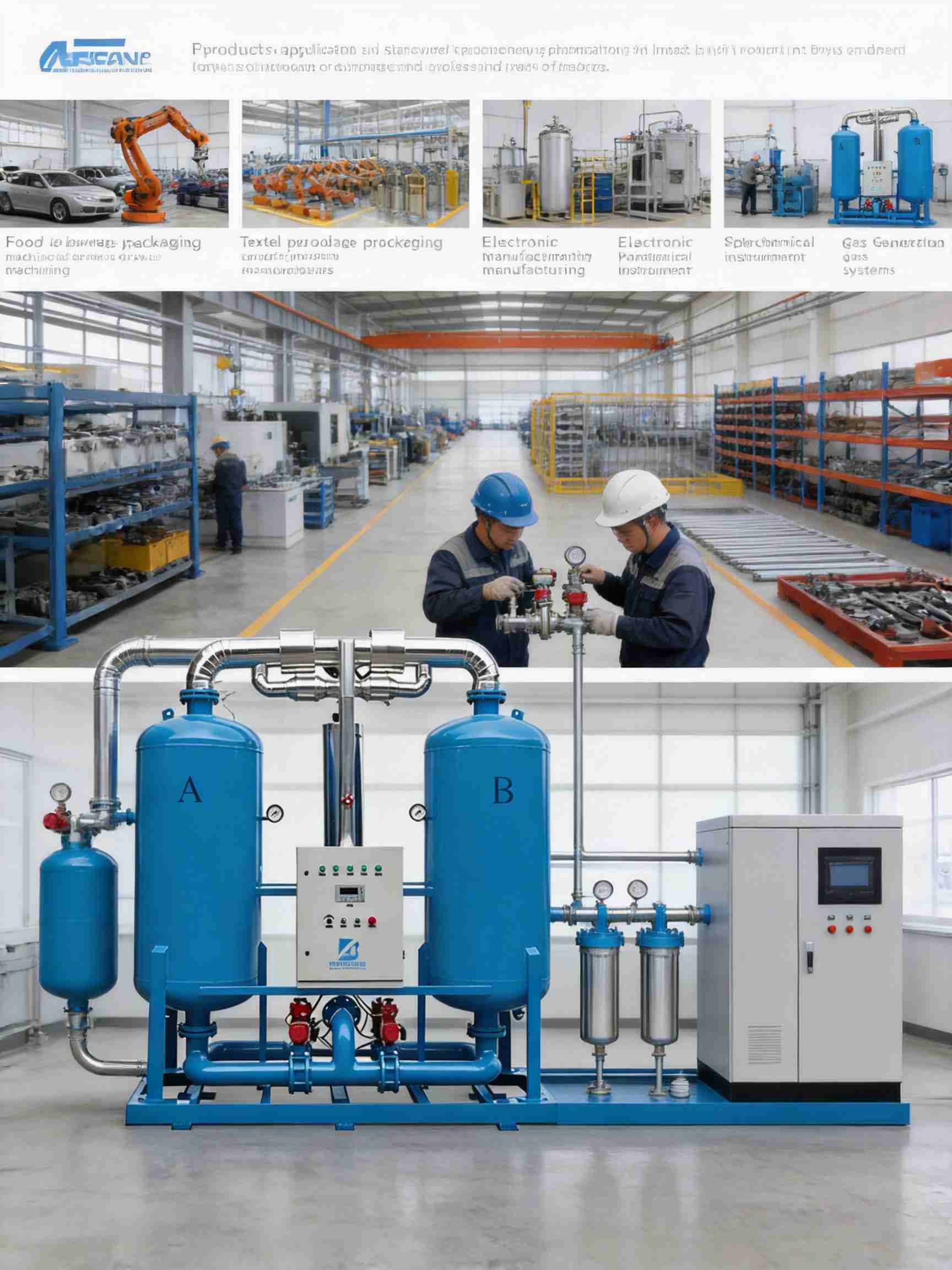
References
1. Product technical specification for the BEL Micro-heat Regenerative Adsorption Dryer, Zhejiang Baiao Gas Equipment Co., Ltd.
2. General principles of compressed-air treatment and regenerative adsorption drying.
3. Industrial guidance on pressure dew point, moisture control, and pneumatic-system reliability.
4. Manufacturer information concerning gas separation, gas purification, equipment manufacturing, installation, and after-sales service.
5. General engineering practice for compressed-air filtration, condensate management, adsorption-vessel operation, and preventive maintenance.
Product: BEL Micro-heat Regenerative Adsorption Dryer

- Tel: +86-15057127179
+86-13588382771 - Email: huang.yifan0215@gmail.com
- Address: Huanshan Township, Fuyang District, Hangzhou City, Zhejiang Province
Copyright © Zhejiang Baiao Gas Equipment Co., Ltd. All Rights Reserved.
Privacy
Gas Generator Plant Manufacturer, Industrial Purification Equipment Plant
